

VALID New-Jersey-Real-Estate-Salesperson Exam Dumps For Certification Exam Preparation
New-Jersey-Real-Estate-Salesperson Dumps PDF 2026 Strategy Your Preparation Efficiently
NEW QUESTION # 13
According to the New Jersey Real Estate Time Share Act, if a licensee is selling a timeshare located within the state of New Jersey, all of the following are true EXCEPT that the:
- A. licensee must hold a timeshare sales license.
- B. timeshare must be approved by the Real Estate Commission.
- C. contract of sale must provide notice of a seven calendar day rescission period.
- D. licensee must provide the buyer with a copy of the Public Offering Statement.
Answer: A
Explanation:
Under the NJ Real Estate Time Share Act (N.J.S.A. 45:15-16.50 et seq.), timeshares sold in New Jersey must be registered with the NJ Real Estate Commission.
Buyers must be given a Public Offering Statement.
Buyers are entitled to a 7-calendar-day rescission period.
There is no separate "timeshare sales license" - a standard NJ real estate license is sufficient.
Thus, the false statement is A.
Reference: New Jersey Real Estate Time Share Act; NJ Real Estate Salesperson Study Guide, Chapter on Timeshares and Condominiums.
NEW QUESTION # 14
What is the difference between a license to use property and an easement?
- A. There must be consideration paid for a license.
- B. There must be consideration paid for an easement.
- C. An easement can be cancelled by the issuer.
- D. A license can be cancelled by the issuer.
Answer: D
Explanation:
A license is a personal, revocable privilege to use another's land for a specific purpose (e.g., permission to fish in a pond). It can be canceled by the issuer at any time and does not run with the land.
An easement is a legal interest in another's land for a specific purpose (e.g., utility easement). It is not revocable by the grantor once legally granted.
Consideration is not required for a license or an easement (though it may be part of a contractual easement).
Thus, the main difference is that a license is revocable by the issuer, but an easement is not.
Reference: NJ Real Estate Salesperson Study Guide, Chapter on Interests in Real Estate.
NEW QUESTION # 15
A licensee faxes a list of available properties to prospective buyers. Which of the following is true?
- A. The licensee must mail an identical list to all parties.
- B. The licensee must include only a phone number to reply.
- C. The fax must contain an opt-out provision for future communications.
- D. The licensee's company's name does not need to be listed.
Answer: C
Explanation:
Under the federal Telephone Consumer Protection Act (TCPA) and Junk Fax Prevention Act:
Any unsolicited fax must include a clear opt-out provision allowing the recipient to request no further communications.
The fax must also identify the sender, including company name.
There is no requirement to mail identical lists.
Correct answer = A.
Reference: Telephone Consumer Protection Act (TCPA); Junk Fax Prevention Act; NJ Real Estate Salesperson Study Guide, Chapter on Advertising Rules.
NEW QUESTION # 16
A city has built a new library and has contacted the broker to list and sell the old library building. Which approach should the broker use to estimate the fair market value for the purpose of listing and selling this property?
- A. income approach
- B. replacement cost
- C. gross rent multiplier
- D. sales comparison
Answer: B
Explanation:
For special-purpose properties such as schools, churches, libraries, or government buildings, there are typically few comparable sales and the properties are not income-producing.
In these cases, appraisers use the cost (replacement) approach, which estimates the value by calculating the cost of replacing the structure minus depreciation, plus land value.
Correct answer: C. replacement cost.
Reference: NJ Real Estate Salesperson Study Guide, Chapter on Appraisal Methods (Cost Approach for Special-Purpose Properties).
NEW QUESTION # 17
To avoid triggering full disclosure under TILA when advertising financing availability on a listed property, which of the following statements must a real estate licensee avoid using?
- A. owner willing to finance
- B. assumable loan
- C. FHA and VA financing available
- D. buy for less than $650 per month
Answer: D
Explanation:
Under the Truth in Lending Act (Regulation Z), advertising is regulated to prevent misleading credit offers.
If an ad uses "triggering terms" (such as monthly payment amount, interest rate, down payment, or loan term), then full disclosure of all financing terms must be provided.
"Buy for less than $650 per month" is a triggering term because it specifies a monthly payment.
General terms like "assumable loan," "owner financing," or "FHA/VA available" are permissible without full disclosure.
Correct answer = D.
Reference: Truth in Lending Act (TILA), Regulation Z; NJ Real Estate Salesperson Study Guide, Chapter on Financing and Advertising Rules.
NEW QUESTION # 18
Standard title insurance would protect a buyer:
- A. if after closing, the HOA placed a lien on the property for the previous owners' unpaid dues.
- B. in a purchase where the buyer had knowledge of a shed violating setback requirements.
- C. for the purchase of a property bought sight unseen where the buyer discovers a tenant living at the property.
- D. when the seller has forged an ex-partner's signature on the deed.
Answer: D
Explanation:
Standard title insurance protects against defects in title that existed before closing, such as forged documents, undisclosed heirs, or improperly executed deeds.
It does not cover issues arising after closing (like new HOA liens).
It does not protect against defects the buyer already knew about.
It also does not insure physical possession or condition of property.
Thus, the correct answer is A.
Reference: NJ Real Estate Salesperson Study Guide, Chapter on Title and Title Insurance.
NEW QUESTION # 19
Limiting the neighborhoods in which a licensee shows houses because of a buyer's race is:
- A. puffing
- B. blockbusting
- C. redlining
- D. steering
Answer: D
Explanation:
Steering = Directing or discouraging buyers from certain neighborhoods based on race, religion, or other protected classes. This violates the Federal Fair Housing Act.
Blockbusting = Inducing owners to sell by suggesting a protected class moving into the neighborhood will lower values.
Redlining = Refusing loans or insurance in certain neighborhoods.
Puffing = Exaggerated sales talk, not discriminatory.
Therefore, the action described = steering.
Reference: Federal Fair Housing Act (1968, as amended); NJ Real Estate Salesperson Study Guide, Chapter on Fair Housing Practices.
NEW QUESTION # 20
A licensee must provide a Consumer Information Statement in all of the following transactions EXCEPT the:
- A. sale of a three-family house in a mixed-use zone
- B. sale of a vacant one-family lot
- C. lease of a three-bedroom apartment for one year
- D. sublease of a studio apartment for two months
Answer: D
Explanation:
The Consumer Information Statement (CIS) must be used in all sales of 1-4 family residential properties and all residential lease transactions of 1-4 units that are for terms longer than 125 days.
A short-term rental or sublease (two months) does not require a CIS.
Correct answer = C.
Reference: N.J.A.C. 11:5-6.9; NJ Real Estate Salesperson Study Guide, Chapter on Consumer Information Statement.
NEW QUESTION # 21
A seller places a property on the market for sale at a certain price. A buyer sees the property and makes a written offer to purchase that is 90% of the asking price. The seller rejects that offer, but will accept an offer of 95% of the original asking price. The buyer rejects that counteroffer. The original offer is:
- A. irrevocable
- B. binding
- C. null and void
- D. rescinded
Answer: C
Explanation:
Once an offer is rejected or countered, the original offer is terminated and cannot be revived unless resubmitted.
A counteroffer legally cancels the original offer.
Therefore, the buyer's initial offer is null and void once the seller counters.
Correct answer = B.
Reference: NJ Real Estate Salesperson Study Guide, Chapter on Contracts and Offers.
NEW QUESTION # 22
A married couple is planning to purchase a house that costs $86,000. If they obtain a 60% loan and the lender charges a 2.5% loan origination fee and 0.5 discount points, what is the cost of these expenses?
- A. $2,580
- B. $2,150
- C. $1,290
- D. $1,548
Answer: D
Explanation: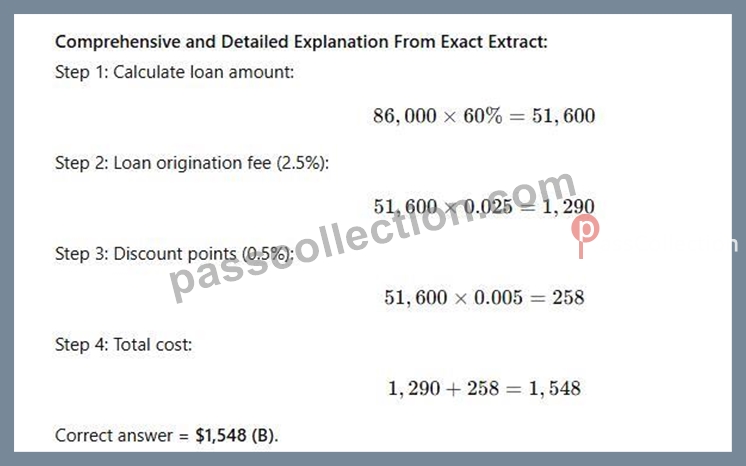
Reference: New Jersey Real Estate Salesperson Pre-Licensure Course Guide, Chapter on Financing and Loan Calculations.
NEW QUESTION # 23
A property was listed for $110,000. It sold for $106,000. A 6.5% fee was split equally between the listing and selling real estate firms. The listing licensee received 55% of the listing office share. How much did the listing licensee receive?
- A. $3,575.00
- B. $3,789.50
- C. $1,966.25
- D. $1,894.75
Answer: D
Explanation: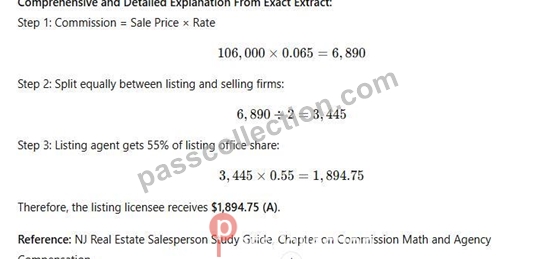
NEW QUESTION # 24
In surveying, monuments are used to establish:
- A. real estate boundaries
- B. historical sites
- C. flood elevation
- D. a common address
Answer: A
Explanation:
Monuments are fixed physical objects (iron pins, concrete markers, trees, rocks) used by surveyors to establish property boundaries in the metes-and-bounds system.
They do not establish addresses, flood elevations, or historical sites.
Correct answer = B.
Reference: NJ Real Estate Salesperson Study Guide, Chapter on Legal Descriptions and Surveys.
NEW QUESTION # 25
After announcing that a new city park will soon be developed, homes in the immediate area experience a rise in value. This is an example of which of the following principles of value?
- A. anticipation
- B. contribution
- C. change
- D. highest and best use
Answer: A
Explanation:
Principle of anticipation: Value is created by the expectation of future benefits (e.g., new park development).
Change: value is constantly influenced by natural and economic changes.
Contribution: value of an improvement is measured by its contribution to the property's value.
Highest and best use: most profitable legal use of the land.
Here, the increase is due to anticipated future benefits # C.
Reference: NJ Real Estate Salesperson Study Guide, Chapter on Appraisal Principles.
NEW QUESTION # 26
A broker is offering a $100 gift certificate at a jewelry store to all sellers who list with the broker during a specified time period. According to the New Jersey Real Estate License Law, such a promotion is prohibited because it:
- A. offers compensation for brokerage activity to unlicensed persons
- B. discriminates against sellers who do not list with the broker during the specified time period
- C. discriminates against sellers whose religion prohibits the wearing of jewelry
- D. makes the receipt of the free offering contingent upon sellers listing their properties with the broker
Answer: D
Explanation:
According to NJ Real Estate Commission rules, brokers and salespersons may not:
Offer prizes, gifts, or inducements that are contingent on entering into a listing agreement.
This is considered an improper inducement under N.J.A.C. 11:5-6.4.
Therefore, the prohibition is because the gift certificate is conditioned on the seller listing with the broker.
Reference: NJREC Rules and Regulations, N.J.A.C. 11:5-6.4 (Advertising and Inducements).
NEW QUESTION # 27
The primary intent of the statute of frauds is to:
- A. protect licensees from fraudulent activity.
- B. reduce real estate contracts to writing.
- C. enforce oral agreements beyond 1 year.
- D. protect the rights of buyers who are disabled.
Answer: B
Explanation:
The Statute of Frauds (as adopted in New Jersey) requires that certain contracts be in writing to be enforceable, including:
Contracts for the sale of real estate.
Leases longer than 3 years.
Certain other long-term agreements.
Its purpose is to prevent fraud and misunderstandings by requiring written evidence of important contracts.
Reference: N.J.S.A. 25:1-13; NJ Real Estate Salesperson Study Guide, Chapter on Contracts.
NEW QUESTION # 28
The Freshwater Wetlands Protection Act of 1987 is a New Jersey law that:
- A. restricts development of real estate in certain designated areas
- B. requires the registration of residential development projects with the New Jersey Department of Community Affairs
- C. empowers the New Jersey Department of Environmental Protection to acquire title to certain real estate for less than its fair market value through condemnation
- D. requires environmental impact statements to be filed with the New Jersey Department of Environmental Protection before title to developed real estate can be transferred
Answer: A
Explanation:
The Freshwater Wetlands Protection Act (1987) gives the New Jersey Department of Environmental Protection (NJDEP) the authority to regulate activities in freshwater wetlands and transition areas (buffer zones). Its primary purpose is to restrict development in wetlands and certain protected areas to preserve environmental resources.
It does not require environmental impact statements prior to transfer of title, does not authorize below-market condemnation, and is unrelated to DCA residential project registration.
Reference: New Jersey Real Estate Salesperson Pre-Licensure Course Guide, Chapter on Environmental Issues; Freshwater Wetlands Protection Act, N.J.S.A. 13:9B-1 et seq.
NEW QUESTION # 29
Last year, an apartment building had a net operating income of $174,000. If a potential buyer is looking for a capitalization rate of 8%, how much should the buyer be willing to pay for the building?
- A. $139,200
- B. $1,392,000
- C. $174,000
- D. $2,175,000
Answer: B
Explanation:
The Income Capitalization Approach formula is: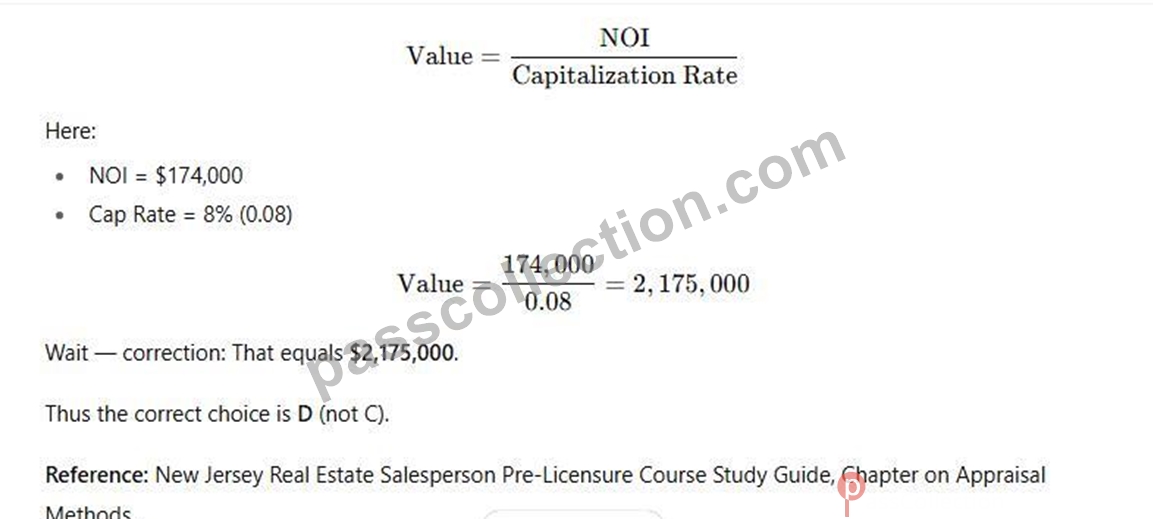
NEW QUESTION # 30
A broker maintains a real estate agency and terminated two salespersons. In this situation, the broker is REQUIRED to take all the following actions with regard to these two salespersons EXCEPT:
- A. permit them to remove original sales or listing contracts from the broker's office.
- B. abide by the post-termination compensation clause contained in their employment agreements or provide a written explanation for not doing so.
- C. provide each with a written accounting of all monies due each salesperson.
- D. pay any undisputed compensation due within ten days of the broker's receipt of such funds.
Answer: A
Explanation:
According to NJREC Rules and Regulations (N.J.A.C. 11:5-4.1) and the Broker-Salesperson employment agreement requirements:
Brokers must provide a full written accounting of monies due.
Any undisputed commission due must be paid within 10 business days of the broker receiving the funds.
The broker must honor the compensation provisions of the terminated salesperson's written employment agreement.
However, salespersons are not permitted to remove original sales or listing contracts, which remain the property of the broker.
Therefore, the action the broker is NOT required to take is B.
Reference: NJREC Rules and Regulations, N.J.A.C. 11:5-4.1 (Employment Agreements and Compensation).
NEW QUESTION # 31
A married couple is purchasing a home. They ask the salesperson to advise them regarding the best way to take title. The salesperson should
- A. ask a broker to make a recommendation.
- B. explain the possible types of joint ownership so they understand the options.
- C. advise them to take title as tenants by the entirety.
- D. decline to advise them and suggest that they consult an attorney.
Answer: D
Explanation:
According to the NJ Real Estate Commission regulations on licensee conduct and the Salesperson Study Guide (Agency & Professional Practice section), licensees may explain types of ownership but must not give legal advice or recommend a specific method of taking title. Advising how to take title (e.g., tenants by the entirety, joint tenancy, tenancy in common) constitutes the practice of law. The proper action is to refer the buyers to an attorney.
Therefore, the correct answer is C.
(Reference: NJ Real Estate Salesperson Pre-Licensure Course Study Guide, Professional Responsibilities & Avoiding Unauthorized Practice of Law.)
NEW QUESTION # 32
In commercial property leasing, listing agents should ensure that the owner complies with:
- A. state and federal Fair Housing laws
- B. their fiduciary responsibilities to the tenant
- C. the Americans with Disabilities Act
- D. market lease rates
Answer: C
Explanation:
In commercial leasing, the Americans with Disabilities Act (ADA) applies.
The ADA requires that public accommodations and commercial facilities be accessible to persons with disabilities.
Fair Housing laws apply mainly to residential property, not commercial.
Fiduciary duties are owed by the agent to their client, not by an owner to tenants.
Market lease rates are economic factors, not legal requirements.
Correct answer = C.
Reference: Americans with Disabilities Act (ADA, 1990); NJ Real Estate Salesperson Study Guide, Chapter on Commercial Real Estate.
NEW QUESTION # 33
A contract is delivered to the listing broker by a cooperating broker. The listing broker makes an appointment with the owner to present the offer at 7 p.m. of that day. Before 7 p.m., two more offers arrive on the same property. Which offer should be presented to the owner at the 7 p.m. appointment?
- A. the offer with the highest sale price
- B. all three of the offers
- C. the first offer received
- D. the offer most favorable to the seller, including price and all terms
Answer: B
Explanation:
Under NJREC rules and fiduciary duties:
A licensee must present all written offers to the seller immediately but no later than 24 hours after receipt.
The seller has the right to consider every offer, regardless of sequence or perceived favorability.
Therefore, at the 7 p.m. appointment, the listing broker must present all three offers.
Correct answer = A.
Reference: NJREC Rules and Regulations, N.J.A.C. 11:5-6.9; NJ Real Estate Salesperson Study Guide, Chapter on Offers.
NEW QUESTION # 34
In advertisements of individual salespersons, which of the following is permitted?
- A. Placing the real estate office sign on a personal residence.
- B. Including reference to a home office.
- C. Having the broker's name appear in smaller print than the salesperson's name in a newspaper ad.
- D. Linking a personal real estate webpage to the salesperson's broker's website.
Answer: D
Explanation:
The New Jersey Real Estate Commission advertising rules (N.J.A.C. 11:5-6.4) state that:
All ads must clearly indicate the name of the employing broker.
A salesperson's name may appear, but not more prominently than the broker's name.
Ads cannot suggest that a salesperson is operating independently.
Linking a salesperson's personal webpage to their broker's official website is permissible, provided the broker's name is prominently displayed and supervision is maintained.
Therefore, the only correct permitted action is D.
Reference: NJREC Rules and Regulations, N.J.A.C. 11:5-6.4 (Advertising Rules).
NEW QUESTION # 35
If a salesperson or broker-salesperson maintains a webpage that is not linked to the webpage of their broker, the licensee's webpage must display the name of the broker as well as the
- A. address of the branch office from which the licensee operates.
- B. broker's email address.
- C. address of the broker's main office.
- D. broker's telephone number.
Answer: C
Explanation:
Under NJREC advertising rules (N.J.A.C. 11:5-6.1), any licensee maintaining an independent website (not directly linked to the broker's official site) must clearly and prominently display:
The name of their employing broker, and
The main office address of the broker.
This ensures the public understands the licensee works under a supervising broker, and prevents misleading advertising. It is not sufficient to only list a branch office or email.
Therefore, the correct answer is C.
Reference: NJREC Rules and Regulations, N.J.A.C. 11:5-6.1 (Advertising Requirements).
NEW QUESTION # 36
......
Latest Verified & Correct New-Jersey-Real-Estate-Salesperson Questions: https://www.passcollection.com/New-Jersey-Real-Estate-Salesperson_real-exams.html
100% Pass Guaranteed Download New Jersey Real Estate Exam PDF Q&A: https://drive.google.com/open?id=1vfnMsDNcR-iJ00qJJzTMCjHjtfYGWusW
