

UiPath UiPath-TAEPv1 Dumps Questions [2025] Pass for UiPath-TAEPv1 Exam
Updated UiPath Study Guide UiPath-TAEPv1 Dumps Questions
NEW QUESTION # 28
One requirement of the organization's testing strategy is to attach a screenshot to a test case execution whenever it fails. How can this be achieved?
- A. Use a Take Screenshot activity and set its AttachToExecution property to True.
- B. Use the Attach Document activity and set its AttachmentType property to Screenshot.
- C. Use one of the Verify activities and set its TakeScreenshotlfFailed property to True.
- D. Surround the Verity activity in a Try Catch and use a Take Screenshot activity in the Catch block.
Answer: C
Explanation:
To automatically attach a screenshot upon test failure, use one of the Verify activities and set the TakeScreenshotIfFailed property to True. This ensures that a screenshot is captured and attached only when the verification fails.
NEW QUESTION # 29
How are test cases added dynamically to a Test Set based on labels in UiPath Test Manager?
- A. Test Cases with all of the selected labels are assigned to the Test Set.
- B. Test Cases with a specified number of the selected labels are assigned to the Test Set.
- C. Test Cases with any of the selected labels are assigned to the Test Set.
- D. Only the manual and automated labels are used to assign Test Cases to the Test Set.
Answer: C
Explanation:
In UiPath Test Manager, when using labels to dynamically assign test cases to a Test Set, any test case that matches any of the selected labels will be added. This enables flexible grouping based on shared characteristics.
NEW QUESTION # 30
What type of data sources can be used for a data-driven test that will be developed using UiPath Test Suite on Premises version?
- A. File (Excel and CSV)
Auto Generate
Data Service
Test Data Queue - B. File (Excel and CSV)
Data Service
Existing data already Stored in the Test Data folder of the project
Test Data Queue - C. File (Excel and CSV)
Auto Generate
Data Service
Existing data already Stored in the Test Data folder of the project - D. File (Excel and CSV)
Auto Generate
Existing data already Stored in the Test Data folder of the project
Test Data Queue
Answer: D
Explanation:
In UiPath Test Suite On-Premises, supported data sources for data-driven tests include:
File (Excel and CSV)
Auto Generate
Existing data stored in the Test Data folder of the project
Test Data Queue
These options allow flexible management and variation of test inputs for automated testing.
NEW QUESTION # 31
What happens to the arguments when creating a test case from a workflow?
- A. Arguments from the workflow are transformed into variables in the test case.
- B. Arguments from the workflow need to be manually imported into the test case.
- C. Arguments from the workflow are deleted and must be redefined.
- D. Arguments from the workflow are automatically imported into the test case.
Answer: D
Explanation:
When creating a test case from a workflow in UiPath Studio, the arguments from the workflow are automatically imported into the test case. This allows the test case to simulate the input/output behavior of the original workflow without needing to redefine the arguments.
NEW QUESTION # 32
What conclusions can be drawn from the exhibit?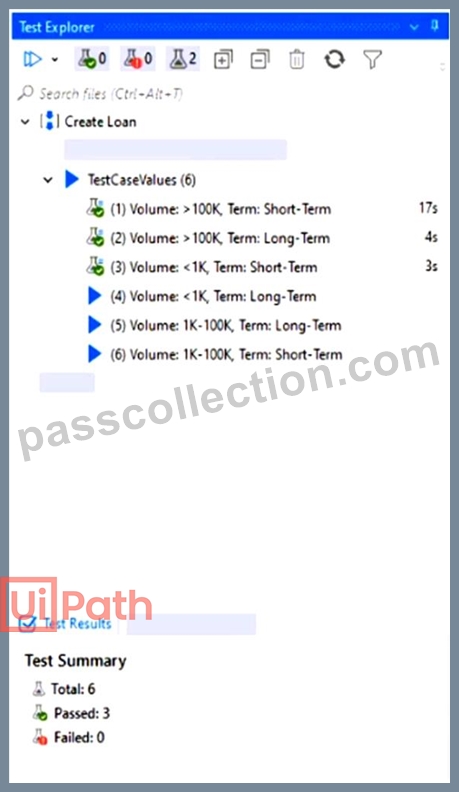
- A. It's a data-driven test case with 2 variations, 2 variations were run and 2 not yet run.
- B. It's a data-driven test case with 3 variations, 3 variations were run and 3 not yet run.
- C. It's a data-driven test case with 6 variations, 3 variations were run and 3 not yet run.
- D. It's an automated test case with 8 variations.
Answer: C
Explanation:
The Test Explorer shows a data-driven test case named "Create Loan" with 6 variations under TestCaseValues. Out of these, 3 have green flask icons (indicating they were run and passed), while 3 have blue play icons (indicating they have not yet been executed).
NEW QUESTION # 33
What is application testing in the context of UiPath?
- A. An application testing works with large data sets to verify workflow execution and covers corer cases.
- B. An application testing creates test cases that verify RPA workflow outputs.
- C. An application testing invokes different test frameworks and retrieves the results.
- D. An application testing executes an RPA process and verifies the results.
Answer: D
Explanation:
In the context of UiPath, application testing refers to executing an RPA process and verifying the results to ensure that the application or workflow behaves as expected under various conditions.
NEW QUESTION # 34
When creating a new test set in UiPath Orchestrator, what is the purpose of using a wildcard symbol (*) for the project version?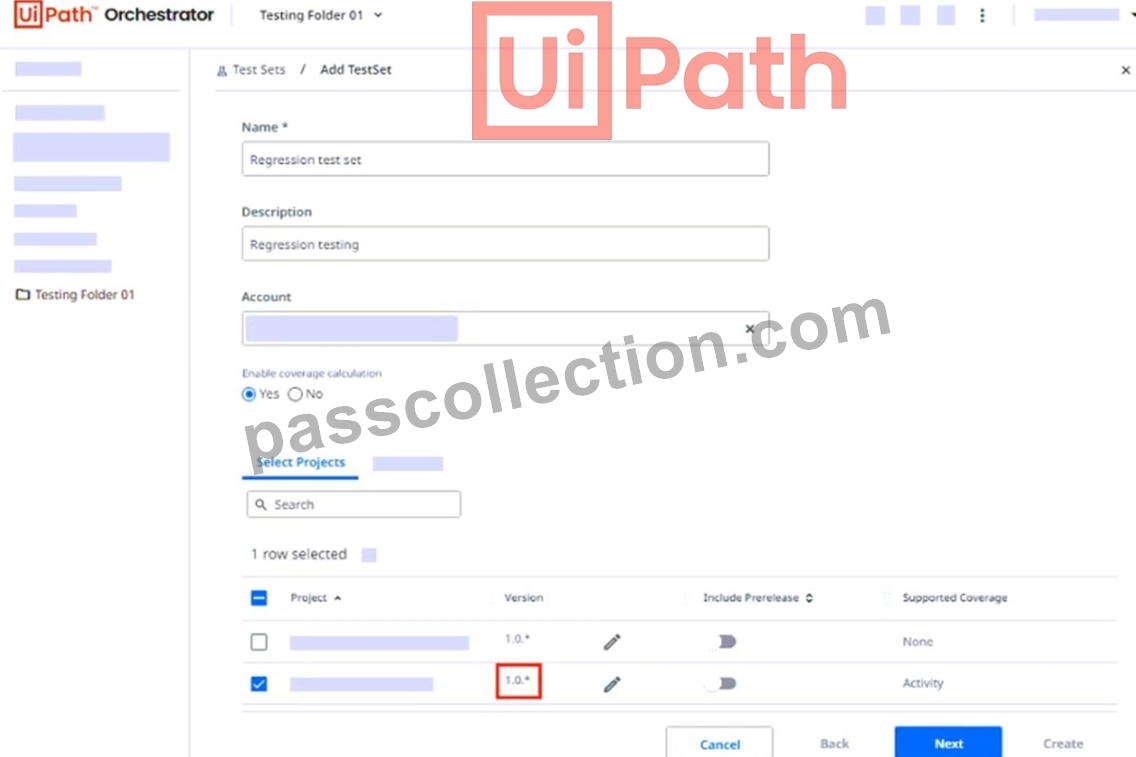
- A. The first project version starting with 1.0. will be used.
- B. Any project version starting with 1.0. will be used.
- C. The latest project version starting with 1.0. will be used.
- D. A validation error will be displayed after clicking on the Next button.
Answer: C
Explanation:
In UiPath Orchestrator, using a wildcard symbol (*) in the project version (e.g., 1.0.*) means that the latest available version that starts with 1.0. will be used when the test set is executed. This helps ensure the most recent compatible package is always selected.
NEW QUESTION # 35
What is a primary distinction between manual and automated test execution in UiPath Test Manager?
- A. Manual executions are done for test sets created in UiPath Test Manager or linked from Orchestrator with manual steps, while automated executions are invoked through Orchestrator for test cases linked from Studio.
- B. Manual and automated test executions do not have specific distinctions and can be executed interchangeably.
- C. Manual executions require user interaction for each test step, while automated executions are self-running without any manual intervention.
- D. Automated test executions can be performed only in UiPath Orchestrator, while manual executions can only be performed in UiPath Test Manager.
Answer: C
Explanation:
The primary distinction is that manual executions require user interaction for each test step, making them suitable for scenarios like exploratory testing or steps requiring human validation. In contrast, automated executions are fully self-running, executed via Orchestrator without manual involvement.
NEW QUESTION # 36
Which of the following descriptions matches the concept of Integration Testing?
- A. Individual units are combined and tested as a group. The purpose of this level of testing is to expose faults in the interaction between integrated units.
- B. Evaluate the system's compliance with the business requirements and assess whether it is acceptable for delivery.
- C. Individual units of a system are tested. The purpose is to validate that each unit of the system code performs as expected.
- D. Validates the complete and fully integrated system. The purpose of a system test is to evaluate the end-to-end system specifications.
Answer: A
Explanation:
Integration Testing focuses on testing combined units of a system to ensure they work together correctly. The goal is to detect issues in the interaction between modules or components after they are integrated.
NEW QUESTION # 37
What type(s) of license should be used in order to be able to connect Studio to Test Manager?
- A. Just Test Manager license.
- B. Studio license and Orchestrator license.
- C. Just Task Capture license
- D. Studio license and Test Manager license.
Answer: D
Explanation:
To connect UiPath Studio to Test Manager, both a Studio license and a Test Manager license are required. This ensures that Studio can interact with Test Manager for managing and executing test cases.
NEW QUESTION # 38
A developer needs to design a coded automation that approves or denies a loan application based on the loan rate. How should the Execute() entry point method be declared if it needs to return the value for (IsLoanApproved), based on the loan rate (LoanRate)?
- A. public bool Execute (bool IsLoanApproved, int loanRate)
- B. public int Execute (bool IsLoanApproved)
- C. public (bool IsLoanApproved) Execute(int LoanRate)
- D. public (int LoanRate) Execute(bool IsLoanApproved)
Answer: A
Explanation:
The correct method signature for a coded automation in UiPath that needs to process input (loanRate) and return a value (IsLoanApproved) is:
**public bool Execute(bool IsLoanApproved, int loanRate)**
This follows the standard format where input parameters are passed to the method, and the result is returned via the method's return type.
NEW QUESTION # 39
What are the two methods for executing tests and where are they invoked??
- A. Manual and Scripted; invoked in Orchestrator only
- B. Manual and Automated; invoked in Test Manager only.
- C. Manual and semi-automated: invoked in Studio.
- D. Manual and Automated; invoked in Test Manager and Orchestrator.
Answer: D
Explanation:
The two methods for executing tests in UiPath are Manual and Automated. These can be invoked from both Test Manager and Orchestrator, depending on whether the execution is user-triggered or scheduled/triggered via CI/CD.
NEW QUESTION # 40
How can manual steps be marked in a Test Case as passed or failed in the Manual Execution Assistant?
- A. Click "Set Failed" or "Set Passed" at the end of the test.
- B. Use the "Execute Manually" button.
- C. Click "Set Failed" or "Set Passed" for each step.
- D. Only automated steps can be marked; manual steps are automatically passed.
Answer: A
Explanation:
In the Manual Execution Assistant of UiPath Test Manager, manual steps can be marked as passed or failed by clicking "Set Failed" or "Set Passed" at the end of the test. This allows the tester to indicate the outcome of the manual step after execution.
NEW QUESTION # 41
Which are the sub-tasks available under test task in UiPath CLI?
- A. Convert: converts test results written as CSV to another format.
Run: tests a given package, or runs an existing Test Set on Orchestrator. - B. Convert: converts test results written in JSON to another format.
Run: tests a given package, or runs an existing Test Set on Orchestrator. - C. Convert: converts test results written in JSON to another format.
Test: tests a given package. - D. Convert: converts test results written in JSON or CSV to another format.
Run: tests a given package, or runs an existing Test Set on Orchestrator.
Answer: D
Explanation:
Run: runs an existing Test Set on Orchestrator.
Explanation:
In the UiPath CLI, the test task includes the following sub-tasks:
These enable integration of test execution and reporting into CI/CD pipelines.
NEW QUESTION # 42
What are the specific benefits of using coded automations in UiPath?
- A. Coded automations are primarily used to create structured code with no enhanced productivity, performance improvement, or increased readability.
- B. Coded automations are used only in complex automation scenarios and they have no role in productivity, performance, hybrid automation or code readability.
- C. Coding can increase productivity, manage complex automation scenarios, work seamlessly with low-code automations, enhance performance, and improve code readability.
- D. Coded automations allow to work with low-code automations only, manage basic automation scenarios and developers find it challenging to maintain the code.
Answer: C
Explanation:
Coded automations in UiPath bring several benefits, including increased productivity, the ability to manage complex automation scenarios, seamless integration with low-code automations, improved performance, and better code readability. This enables developers to write more efficient and maintainable code, especially in scenarios where complex logic or custom functions are required.
NEW QUESTION # 43
There is a test case that performs multiple verifications.
How can the test case be configured so that the execution stops when a verification fails?
- A. Set the property ContinueOnFailure of the Verify activities to False.
- B. Use a Stop Job activity after each verification.
- C. Use a Terminate Workflow activity after each verification.
- D. Set the property ContinueOnFailure of the first Verify activity to False.
Answer: A
Explanation:
To ensure that the test case stops execution when a verification fails, you should set the ContinueOnFailure property of the Verify activities to False. This way, any failed verification will halt the test case immediately.
NEW QUESTION # 44
What is the sequence of execution of the main blocks of a Test Case that has Test Automation Framework attached?
Instructions: Drag the Description found on the left and drop on the correct Sequence of Execution found on the right.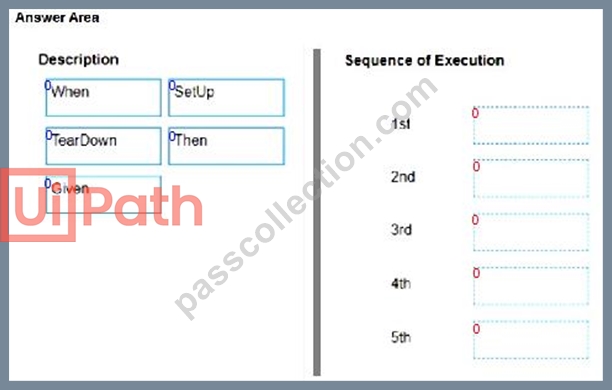
Answer:
Explanation: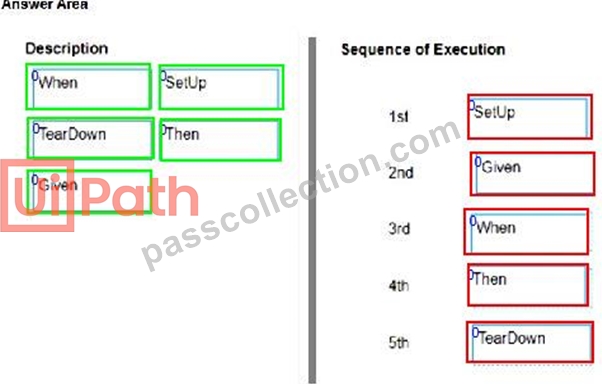
NEW QUESTION # 45
......
UiPath UiPath-TAEPv1 Exam Syllabus Topics:
| Topic | Details |
|---|---|
| Topic 1 |
|
| Topic 2 |
|
| Topic 3 |
|
| Topic 4 |
|
| Topic 5 |
|
| Topic 6 |
|
| Topic 7 |
|
Achieve Success in Actual UiPath-TAEPv1 Exam UiPath-TAEPv1 Exam Dumps: https://www.passcollection.com/UiPath-TAEPv1_real-exams.html
Valid UiPath-TAEPv1 exam with UiPath Real Exam Questions: https://drive.google.com/open?id=19ZaFRN3UkUY0ZrxBhoPjWb1OeO_cYMA5
