

Prepare for the Actual Network Security Administrator SSE-Engineer Exam Practice Materials Collection
Network Security Administrator Certified Official Practice Test SSE-Engineer - Jan-2026
Palo Alto Networks SSE-Engineer Exam Syllabus Topics:
| Topic | Details |
|---|---|
| Topic 1 |
|
| Topic 2 |
|
| Topic 3 |
|
| Topic 4 |
|
NEW QUESTION # 13
In addition to creating a Security policy, how can an AI Access Security be used to prevent users from uploading financial information to ChatGPT?
- A. Apply File Blocking to stop file uploads containing financial information.
- B. Add the ChatGPT domains using URL Filtering to block uploads containing financial information.
- C. Configure an Enterprise DLP rule to block uploads containing financial information.
- D. Apply a vulnerability profile to stop attempts to exploit system flaws or gain unauthorized access to financial systems.
Answer: C
Explanation:
Palo Alto Networks AI Access Security integrates with Enterprise Data Loss Prevention (DLP) capabilities to control sensitive data within AI applications like ChatGPT. The most effective way to prevent users from uploading financial information is to:
* Define an Enterprise DLP rule:This rule would be configured to identify content that matches patterns or keywords associated with financial information (e.g., credit card numbers, bank account details, tax identifiers, financial statements).
* Apply the DLP rule to the AI Access Security policy:This policy would be specifically configured to inspect traffic to and from ChatGPT. When the DLP rule detects a user attempting to upload content containing financial information, it can take a defined action, such as blocking the upload.
Let's analyze why the other options are incorrect based on official documentation:
* A. Apply File Blocking to stop file uploads containing financial information.While File Blocking can prevent the upload of certain file types, it is not content-aware. It cannot inspect thecontentof a file to determine if it contains financial information. Therefore, it's not a granular or effective solution for this specific requirement.
* C. Add the ChatGPT domains using URL Filtering to block uploads containing financial information.URL Filtering controls access to specific websites or categories of websites. While you could potentially block access to ChatGPT entirely, it does not provide the capability to inspect the content being uploaded to a permitted domain and prevent the transfer of sensitive financial data.
* D. Apply a vulnerability profile to stop attempts to exploit system flaws or gain unauthorized access to financial systems.Vulnerability profiles are designed to detect and prevent attempts to exploit known security vulnerabilities in systems. They are not designed to inspect the content of user uploads for sensitive data like financial information. While importantfor overall security, they do not directly address the requirement of preventing financial data uploads to ChatGPT.
Therefore, configuring an Enterprise DLP rule within AI Access Security is the correct and most effective method to prevent users from uploading financial information to ChatGPT by inspecting the content of the uploads.
NEW QUESTION # 14
Which feature can help address a customer concern about the length of time it takes to update their SaaS- allowed IP addresses while onboarding to Prisma Access?
- A. Dedicated IP addresses
- B. Traffic steering
- C. Dynamic IP pooling
- D. DNS-based load balancing
Answer: B
Explanation:
When onboarding toPrisma Access, usingDedicated IP addresseshelps address concerns about the time required to updateSaaS-allowed IP lists. Withdedicated egress IPs, the customer receivesfixed, predictable IP addressesthat do not change dynamically. This eliminates the need to frequently updateSaaS providers' allowlists, ensuring seamless access to cloud applications without interruptions due to IP address changes.
NEW QUESTION # 15
Based on the image below, which two statements describe the reason and action required to resolve the errors? (Choose two.)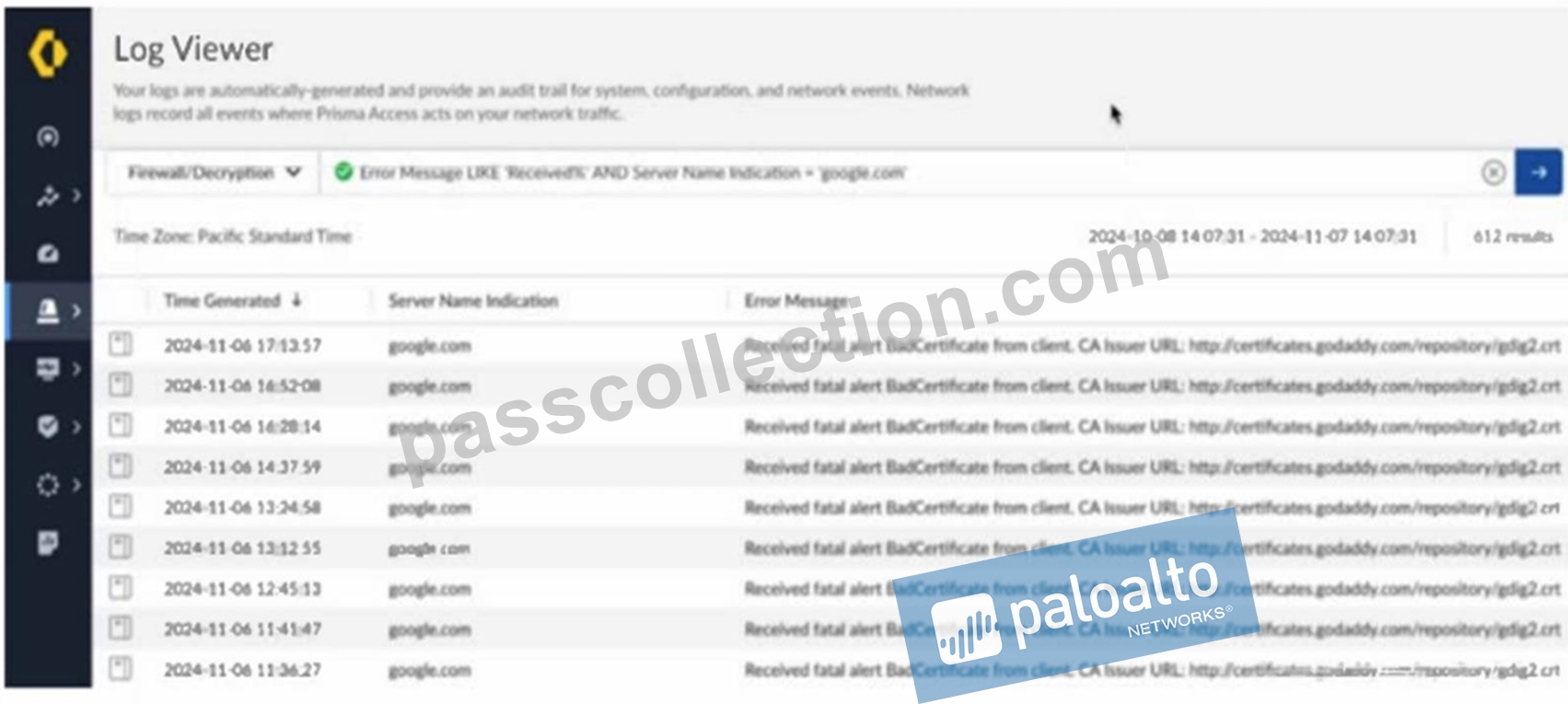
- A. The client is misconfigured.
- B. Create a do not decrypt rule for the hostname "certificates.godaddy.com."
- C. The server has pinned certificates.
- D. Create a do not decrypt rule for the hostname "google.com."
Answer: C,D
Explanation:
The error messages indicate that Prisma Access is encountering certificate issues while attempting to decrypt traffic to "google.com." This suggests that theserver has pinned certificates, meaning it does not allow man- in-the-middle (MITM) decryption by Prisma Access. Since pinned certificates prevent traffic decryption, a solution is tocreate a "do not decrypt" rule for the hostname "google.com."This will allow traffic to flow without triggering certificate errors while maintaining secure communication with Google's servers.
NEW QUESTION # 16
A large retailer has deployed all of its stores with the same IP address subnet. An engineer is onboarding these stores as Remote Networks in Prisma Access. While onboarding each store, the engineer selects the
"Overlapping Subnets" checkbox.
Which Remote Network flow is supported after onboarding in this scenario?
- A. To mobile users
- B. To remote network
- C. To private applications
- D. To the internet
Answer: C
Explanation:
When the "Overlapping Subnets" checkbox is selected during the Remote Network onboarding process in Prisma Access, the deployment enables Private Application access using Prisma Access for Users(ZTNA or Private Access). This feature is designed to handle scenarios where multiple sites use the same IP subnet by leveraging NAT (Network Address Translation) and segmentation to avoid conflicts.
Since overlapping subnets can create routing challenges for direct remote network-to-remote network communication, Prisma Access does not support Remote Network-to-Remote Network or Mobile User communication in this case. Private application access is supported as Prisma Access correctly routes requests based on application-layer intelligence rather than IP-based routing.
NEW QUESTION # 17
When using the traffic replication feature in Prisma Access, where is the mirrored traffic directed for analysis?
- A. Specified internal security appliance
- B. Dedicated cloud storage location
- C. Panorama
- D. Strata Cloud Manager (SCM)
Answer: A
Explanation:
Palo Alto Networks documentation clearly states that when configuring the traffic replication feature in Prisma Access, you mustspecify an internal security applianceas the destination for the mirrored traffic.
This appliance, typically a Palo Alto Networks next-generation firewall or a third-party security tool, is responsible for receiving and analyzing the replicated traffic for various purposes like threat analysis, troubleshooting, or compliance monitoring.
Let's analyze why the other options are incorrect based on official documentation:
* B. Dedicated cloud storage location:While Prisma Access logs and other data might be stored in the cloud, themirrored trafficfor real-time analysis is directly streamed to a designated security appliance, not a passive storage location.
* C. Panorama:Panorama is the centralized management system for Palo Alto Networks firewalls. While Panorama can receive logs and manage the configuration of Prisma Access, it is not the direct destination for real-time mirrored traffic intended for immediate analysis.
* D. Strata Cloud Manager (SCM):Strata Cloud Manager is the platform used to configure and manage Prisma Access. It facilitates the setup of traffic replication, including specifying the destination appliance, but it does not directly receive or analyze the mirrored traffic itself.
Therefore, the mirrored traffic from the traffic replication feature in Prisma Access is directed to a specified internal security appliance for analysis.
NEW QUESTION # 18
Which statement applies when enabling multitenancy in Prisma Access (Managed by Panorama)?
- A. There is flexibility to manage different tenants using separate Panoramas, which allows for better organization and management of the multiple tenants.
- B. Each tenant is allocated its own dedicated Prisma Access instances, with compute resources that are not shared across tenants.
- C. A single tenant cannot consist solely of mobile users or solely of remote networks.
- D. Service connection licenses will be assigned only to the first tenant, and these service connections can be shared with the other tenants.
Answer: B
Explanation:
When multitenancy is enabled in Prisma Access (Managed by Panorama), a key characteristic is the isolation of resources between tenants. Palo Alto Networks documentation emphasizes that each tenant operates within its own logically separate Prisma Access environment. This includes dedicated compute instances, ensuring that the performance and security of one tenant are not impacted by the activities of another.
Let's analyze why the other options are incorrect based on official documentation:
A: Service connection licenses will be assigned only to the first tenant, and these service connections can be shared with the other tenants. This statement is incorrect. In a multitenant Prisma Access deployment, licenses are typically managed and allocated per tenant. While the underlying infrastructure might be shared by Palo Alto Networks, the logical resources and often the licensing are segmented for each tenant. Sharing service connections across completely separate tenants would violate the principle of tenant isolation.
B: A single tenant cannot consist solely of mobile users or solely of remote networks. This statement is incorrect. Prisma Access multitenancy allows for flexibility in how tenants are configured. A tenant can be designed to exclusively serve mobile users, exclusively connect remote networks, or a combination of both, depending on the organizational structure and requirements.
D: There is flexibility to manage different tenants using separate Panoramas, which allows for better organization and management of the multiple tenants. While it is possible to have multiple Panorama instances managing different parts of a large infrastructure, when discussing multitenancy within a single Prisma Access instance (as implied by the question "enabling multitenancy in Prisma Access (Managed by Panorama))", all configured tenants are managed by that single Panorama instance. Managing different tenants with separate Panoramas is a different architectural consideration, not a defining characteristic of enabling multitenancy within one Prisma Access deployment managed by a specific Panorama.
Therefore, the defining characteristic of Prisma Access multitenancy (Managed by Panorama) is the allocation of dedicated Prisma Access instances and compute resources for each tenant, ensuring logical separation and resource isolation
NEW QUESTION # 19
How can a senior engineer use Strata Cloud Manager (SCM) to ensure that junior engineers are able to create compliant policies while preventing the creation of policies that may result in security gaps?
- A. Configure role-based access controls (RBACs) for all junior engineers to limit them to creating policies in a disabled state, manually review the policies, and enable them using a senior engineer role.
- B. Use security checks under posture settings and set the action to "deny" for all checks that do not meet the compliance standards.
- C. Configure an auto tagging rule in SCM to trigger a Security policy review workflow based on a security rule tag, then instruct junior engineers to use this tag for all new Security policies.
- D. Run a Best Practice Assessment (BPA) at regular intervals and manually revert any policies not meeting company compliance standards.
Answer: B
Explanation:
By usingsecurity checks under posture settingsinStrata Cloud Manager (SCM), the senior engineer can enforcepolicy compliance standardsbyautomatically denyingany security policy that does notalign with best practices. This ensures that junior engineers can create policies while preventing configurations that might introduce security gaps. This proactive approacheliminates manual oversightand enforces compliance at the time of policy creation, reducing risk and ensuring consistent security enforcement.
NEW QUESTION # 20
Which overlay protocol must a customer premises equipment (CPE) device support when terminating a Partner Interconnect-based Colo-Connect in Prisma Access?
- A. DTLS
- B. GRE
- C. Geneve
- D. IPSec
Answer: D
Explanation:
When terminating aPartner Interconnect-based Colo-ConnectinPrisma Access, theCustomer Premises Equipment (CPE)must supportIPSecas the overlay protocol. Prisma Access establishes secureIPSec tunnels between theColo-Connect infrastructure and the CPE, ensuringencrypted communicationand reliable connectivity.IPSecprovidessecure site-to-cloud integration, enabling customers to extend their private network securely over the Prisma Access infrastructure.
NEW QUESTION # 21
What is the purpose of embargo rules in Prisma Access?
- A. Blocking traffic from Russia. China, and North Korea only
- B. Blocking connections from specific countries
- C. Allowing traffic only from specific countries
- D. Rate-limiting connections originating from specific countries
Answer: B
Explanation:
Embargo rules inPrisma Accessare designed toblock traffic from specific countriesthat are subject to regulatory or policy-based restrictions. These rules help organizations enforce compliance bypreventing inbound and outbound connectionsto or from regions that may pose security risks or arerestricted due to legal or geopolitical reasons. They are commonly used toalign with government sanctions and corporate security policies.
NEW QUESTION # 22
A malicious user is attempting to connect to a blocked website by crafting a packet using a fake SNI and the correct website in the HTTP host header.
Which option will prevent this form of attack?
- A. Advanced URL Filtering and block "SNI mismatch with Server Certificate (SAN/CN)"
- B. Advanced URL Filtering and block the "Malicious Behavior" category
- C. Advanced Threat Prevention option to block "Domain Fronting"
- D. SSL Decryption to "Block sessions on SNI mismatch with Server Certificate (SAN/CN)"
Answer: D
Explanation:
This option ensures thatSSL Decryptionchecks for mismatches between theServer Name Indication (SNI) fieldin the TLS handshake and theCommon Name (CN) or Subject Alternative Name (SAN) in the server certificate. If a malicious user tries to bypass content filtering by spoofing theSNI while using the real blocked website in the HTTP host header, this setting will detect the discrepancy andblock the session, preventing unauthorized access.
NEW QUESTION # 23
All mobile users are unable to authenticate to Prisma Access (Managed by Strata Cloud Manager) using SAML authentication through the Cloud Identity Engine. Users report that after entering their credentials on the Identity Provider (IdP) login page, they are redirected to the Prisma Access portal without successful authentication, and they receive this error message:
Error: Prisma Access Portal Authentication Failed using CIE-SAML with message "400 Bad Request" Which action will identify the root cause of this error?
- A. Verify the SAML metadata configuration in both the Cloud Identity Engine and the IdP portal to confirm that the endpoint URLs and certificates are correctly configured.
- B. Review the Authentication logs in Strata Cloud Manager to check for any SAML error messages or authentication failures.
- C. Examine the Security policy rules in Prisma Access to ensure that traffic from the IdP is allowed and not blocked.
- D. Verify the SAML metadata configuration in both Strata Cloud Manager and the IdP portal to confirm that the endpoint URLs and certificates are correctly configured.
Answer: A
Explanation:
The"400 Bad Request"error when attemptingSAML authenticationthrough theCloud Identity Engine (CIE)suggests amisconfiguration in the SAML metadata. This typically occurs when theendpoint URLs, certificates, or entity IDsdo not match betweenCloud Identity Engine and the IdP portal. To resolve this, verify that:
TheSAML metadatauploaded toCloud Identity Enginematches theconfiguration from the IdP.
TheACS (Assertion Consumer Service) URL, Entity ID, and certificateare correctly set.
There are no incorrect or expired certificates in theCloud Identity Engine and IdP configuration.
By ensuring theSAML metadatais properly configured inboth systems, authentication should proceed without errors.
NEW QUESTION # 24
What is the impact of selecting the "Disable Server Response Inspection" checkbox after confirming that a Security policy rule has a threat protection profile configured?
- A. The threat protection profile will override the 'Disable Server Response Inspection1 only for HTTP traffic from the server to the client.
- B. The threat protection profile will override the 'Disable Server Response Inspection1 for all traffic from the server to the client.
- C. Only HTTP traffic from the server to the client will bypass threat inspection.
- D. All traffic from the server to the client will bypass threat inspection.
Answer: D
Explanation:
Selecting the"Disable Server Response Inspection"checkbox means that traffic flowingfrom the server to the clientwillnot be inspectedfor threats, even if a threat protection profile is applied to the Security policy rule. This setting can reduce processing overhead but may expose the network to threats embedded in server responses, such as malware or exploits.
NEW QUESTION # 25
How can a senior engineer use Strata Cloud Manager (SCM) to ensure that junior engineers are able to create compliant policies while preventing the creation of policies that may result in security gaps?
- A. Configure role-based access controls (RBACs) for all junior engineers to limit them to creating policies in a disabled state, manually review the policies, and enable them using a senior engineer role.
- B. Use security checks under posture settings and set the action to "deny" for all checks that do not meet the compliance standards.
- C. Configure an auto tagging rule in SCM to trigger a Security policy review workflow based on a security rule tag, then instruct junior engineers to use this tag for all new Security policies.
- D. Run a Best Practice Assessment (BPA) at regular intervals and manually revert any policies not meeting company compliance standards.
Answer: B
Explanation:
By usingsecurity checks under posture settingsinStrata Cloud Manager (SCM), the senior engineer can enforcepolicy compliance standardsbyautomatically denyingany security policy that does notalign with best practices. This ensures that junior engineers can create policies while preventing configurations that might introduce security gaps. This proactive approacheliminates manual oversightand enforces compliance at the time of policy creation, reducing risk and ensuring consistent security enforcement.
NEW QUESTION # 26
Which two configurations must be enabled to allow App Acceleration for SaaS applications? (Choose two.)
- A. Acceleration agent for the client machines
- B. Forward Trust Certificate for the CA certificate
- C. QoS for user traffic
- D. Trusted Root CA for the CA certificate
Answer: B,D
Explanation:
To enable App Acceleration for SaaS applications in Prisma Access, the following configurations must be enabled:
Trusted Root CA for the CA certificate ensures that Prisma Access can validate and trust the SaaS application's certificates, allowing seamless inspection and acceleration of traffic without security warnings.
Forward Trust Certificate for the CA certificate enables SSL decryption for SaaS applications, allowing Prisma Access to optimize traffic and apply acceleration techniques while maintaining security policies.
NEW QUESTION # 27
Which two actions can a company with Prisma Access deployed take to use the Egress IP API to automate policy rule updates when the IP addresses used by Prisma Access change? (Choose two.)
- A. Enable the Egress IP API endpoint in Prisma Access.
- B. Download a client certificate to authenticate to the Egress IP API.
- C. Copy the Egress IP API Key in the service infrastructure settings.
- D. Configure a webhook to receive notifications of IP address changes.
Answer: B,D
Explanation:
Configuring a webhook allows the company to receive real-time notifications when Prisma Access changes its egress IP addresses, ensuring that policy rules are updated automatically. Downloading a client certificate is necessary for authentication to the Egress IP API, allowing secure API access for retrieving updated IP addresses. These actions ensure that security policies remain effective without manual intervention.
NEW QUESTION # 28
A customer using Prisma Access (Managed by Panorama) wants to monitor traffic patterns across all remote networks and use Strata Logging Service to gather insights on network usage. An engineer notices that some network data is missing from the Application Command Center (ACC).
What should the engineer do to ensure complete data visibility?
- A. Verify that the Panorama web interface has been configured to aggregate logs from both the Panorama data and RN-SPNs.
- B. Enable the Use Data for Pre-Defined Reports' setting in the Logging and Reporting configuration on Panorama.
- C. Reconfigure the Prisma Access remote networks to log directly to Panorama instead of using Strata Logging Service.
- D. Ensure that log forwarding profiles are applied to all Prisma Access policies and directed to Strata Logging Service.
Answer: D
Explanation:
For complete data visibility inPrisma Access (Managed by Panorama),log forwarding profilesmust be applied toall security policiesto ensure that traffic logs are correctly sent toStrata Logging Service. If log forwarding is missing or misconfigured, some traffic data may not appear in theApplication Command Center (ACC), leading to incomplete insights. Verifying and correctly assigning log forwarding ensures that all relevant network activity is captured and available for analysis.
NEW QUESTION # 29
When a review of devices discovered by IoT Security reveals network routers appearing multiple times with different IP addresses, which configuration will address the issue by showing only unique devices?
- A. Delete all duplicate devices, keeping only those discovered using their management IP addresses.
- B. Add the duplicate entries to the ignore list in IoT Security.
- C. Merge individual devices into a single device with multiple interfaces.
- D. Create a custom role to merge devices with the same hostname and operating system.
Answer: C
Explanation:
When network routers appear multiple times with different IP addresses in IoT Security, it is likely because they have multiple interfaces with separate IPs. Merging these entries into a single device with multiple interfaces ensures that the system correctly identifies each router as a unique entity while maintaining visibility across all its interfaces. This approach prevents unnecessary duplicates, improves asset management, and enhances security monitoring.
NEW QUESTION # 30
An engineer has configured IPSec tunnels for two remote network locations; however, users are experiencing intermittent connectivity issues across the tunnels.
What action will allow the engineer to receive notifications when the IPSec tunnels are down or experiencing instability?
- A. Create a new notification profile specifying conditions for remote network IPSec tunnels.
- B. Create a tunnel log notification rule to alert on specified remote network IPSec tunnel conditions.
- C. Set up the operational health dashboard to email alerts for remote Network IPSec tunnel issues.
- D. Select the IPSec tunnel monitoring and notifications checkbox when configuring the remote network IPSec tunnels.
Answer: A
Explanation:
InPrisma Access, configuring anotification profileallows engineers to receive alerts when IPSec tunnels experience downtime or instability. By definingspecific conditions for remote network IPSec tunnels, the notification profile ensures that the engineer is proactively informed abouttunnel failures, flapping, or degraded performance. This approach enables timely troubleshooting and minimizes disruptions for users relying on the IPSec tunnels.
NEW QUESTION # 31
Which feature within Strata Cloud Manager (SCM) allows an operations team to view applications, threats, and user insights for branch locations for both NGFW and Prisma Access simultaneously?
- A. SASE Health Dashboard
- B. Command Center
- C. Branch Site Monitor
- D. Log Viewer
Answer: B
Explanation:
TheCommand CenterwithinStrata Cloud Manager (SCM)provides acentralized view of applications, threats, and user insightsacross bothNGFW (Next-Generation Firewall) and Prisma Access simultaneously. This feature enables theoperations teamto monitorbranch locations, analyzesecurity events, and detect anomalies in real time, offering acomprehensive visibility and threat intelligence interfacefor proactive network and security management.
NEW QUESTION # 32
An engineer configures a Security policy for traffic originating at branch locations in the Remote Networks configuration scope. After committing the configuration and reviewing the logs, the branch traffic is not matching the Security policy.
Which statement explains the branch traffic behavior?
- A. The Security policy did not meet best practice standards and was automatically removed.
- B. The traffic is matching a Security policy in the Prisma Access configuration scope.
- C. The source address was configured with an address object including the branch location prefixes.
- D. The source zone was configured as "Trust."
Answer: B
Explanation:
InPrisma Access, security policies are evaluated based on theirconfiguration scope. If the engineer configured aSecurity policyunder theRemote Networks scope, but traffic from the branch locations is instead matching aSecurity policy under the Prisma Access configuration scope, the intended policy will not take effect. This happens becausePrisma Access evaluates security rules based on the highest-level applicable configuration first, which can override more specific Remote Networks policies.
NEW QUESTION # 33
Which feature will fetch user and group information to verify whether a group from the Cloud Identity Engine is present on a security processing node (SPN)?
- A. SASE Health Dashboard
- B. Prisma Access Locations
- C. Region Activity Insights
- D. User Activity Insights
Answer: A
Explanation:
TheSASE Health Dashboardprovides visibility intouser and group synchronizationbetween theCloud Identity Engine and the Security Processing Nodes (SPNs). It allows administrators to verifywhether a group from the Cloud Identity Engine is properly fetched and available on the SPN for policy enforcement.
This feature helps in troubleshooting identity-based access control issues and ensures thatuser group mappings are correctly applied within Prisma Access.
NEW QUESTION # 34
A user connected to Prisma Access reports that traffic intermittently is denied after matching a Catch-All Deny rule at the bottom and bypassing HIP-based policies. Refreshing VPN connection restores the access.
What are two reasons for this behavior? (Choose two.)
- A. HIP-enforced policy is scheduled for certain hours of the day.
- B. "Collect HIP data' needs to be enabled in the configuration.
- C. User mapping is learned from sources other than gateway authentication.
- D. Firewall loses user mapping due to missed HIP report checks.
Answer: C,D
Explanation:
User mapping learned from sources other thangateway authenticationcan cause intermittent access issues if it conflicts with the expected user identity used in HIP-based policies. If the firewall is associatingthe user with an outdated or incorrect mapping, traffic may not match the intended security policies, leading todenials by the Catch-All Deny rule.
If thefirewall loses user mapping due to missed HIP report checks, the user may temporarily lose access to policies that require a validHost Information Profile (HIP)match. When the VPN connection is refreshed, the HIP check is re-initiated, restoring access until the issue repeats.
NEW QUESTION # 35
......
Ace Palo Alto Networks SSE-Engineer Certification with Actual Questions Jan 20, 2026 Updated: https://www.passcollection.com/SSE-Engineer_real-exams.html
2026 The Most Effective SSE-Engineer with 54 Questions Answers: https://drive.google.com/open?id=1ymvxD-6wx2HaitDh7Q0XtPBzO9hqjUfH
