

Latest The Open Group OGEA-103 Practice Test Questions, TOGAF Enterprise Architecture Combined Part 1 and Part 2 Exam Exam Dumps
Oct-2026 Pass The Open Group OGEA-103 Exam in First Attempt Easily
NEW QUESTION # 93
In which phase(s) of the ADM would you deal with the actions resulting from a transformation readiness assessment?
- A. Phase A
- B. Phase E and F
- C. Phase F
- D. Phase G
Answer: B
Explanation:
According to the TOGAF Standard, 10th Edition, a transformation readiness assessment is a technique that evaluates the preparedness of the organization to undergo a change, and identifies the actions needed to increase the likelihood of a successful outcome. A transformation readiness assessment can be conducted in Phase E: Opportunities and Solutions, and the actions resulting from it can be dealt with in Phase F: Migration Planning 1. In Phase E, the transformation readiness assessment can help to identify the major implementation challenges and risks, and to define the critical success factors and key performance indicators for the architecture project. In Phase F, the actions resulting from the transformation readiness assessment can help to develop a detailed and realistic migration plan, and to address the gaps, issues, and dependencies that may affect the transition to the target architecture 1. References: 1: TOGAF Standard, 10th Edition, Part III: ADM Guidelines and Techniques, Chapter 29: Business Transformation Readiness Assessment.
NEW QUESTION # 94
Which of the following describes a purpose of Architecture Principles?
- A. To establish a common understanding of how to control the business in pursuit of strategic objectives
- B. To describe likely impacts resulting from successful deployment of the target architecture.
- C. To provide a better understanding about the enterprise's culture and values
- D. To form a contract between sponsoring organization and the enterprise architects
Answer: A
Explanation:
Architecture Principles are general rules and guidelines that inform and support the way in which an organization sets about fulfilling its mission. They reflect a level of consensus among the various elements of the enterprise, and form the basis for making future IT decisions. One of the purposes of Architecture Principles is to establish a common understanding of how to control the business in pursuit of strategic objectives, by providing a framework for evaluating and agreeing on the changes that affect the enterprise's architecture3 Reference: 3: The TOGAF Standard, Version 9.2, Part III: ADM Guidelines and Techniques, Chapter 23: Architecture Principles : The TOGAF Standard, Version 9.2, Part IV: Architecture Content Framework, Chapter 31: Architecture Principles
NEW QUESTION # 95
Please read this scenario prior to answering the question
You are employed as an Enterprise Architect at a multinational energy company. The company is committed to reducing its emissions. To achieve this, the company is increasing production of renewable energy and adopting eco-friendly practices.
The company has an Enterprise Architecture (RA) practice and follows the TOGAF standard for its EA framework. The EA team manages all the major projects in the company. The EA team reports to the Chief Technical Officer (CTO), who is the sponsor of the EA program. The Architecture Board is made up of senior leaders from all parts of the company.
The company is starting to invest in developing various kinds of renewable energy projects, including solar, and wind. A large part of the growth in its renewable energy portfolio has come from buying other companies. The company is keen on acquiring small startups and mid-size companies to leverage their technical innovations. This way, the company aims to outperform its competitors, scale rapidly, and establish a presence in new markets.
The existing business and the newly acquired companies are not working well together, which increasingly causes problems. In response, a strategic plan was created and approved. The plan aims to make the merged companies work more effectively together. This will save money by sharing their common assets, including fixed capital assets, research and development facilities, and resources.
The EA team have been asked to oversee the transformation to carry out the strategic plan. A Request for Architecture Work for the project has created and has been approved. The goal is to strengthen the company's position in the market and reduce costs by taking advantage of economies of scale. The Chief Executive Officer (CEO) has stated that to stay competitive and relevant, the company must transform or entirely reinvent its business model.
Refer to the Scenario
What needs to be done to make sure that the company succeeds with the changes and how should risks be managed?
Based on the TOGAF standard, which of the following is the best answer?
- A. The EA team should document the risks associated with the transformation in an Implementation Factor Catalog. This will be used as a record of important decisions during implementation and deployment for the transformation effort. The catalog should list all the factors to consider, their descriptions, and any limitations to consider. These factors can then be used to help evaluate the risks, which can be documented in the Implementation and Migration Plan.
- B. The EA team needs to identify obstacles that could hinder the project. This should include identifying the factors that will impact the transformation, and determining the readiness level for each factor based on a scale that will help the team to understand the urgency, readiness, and degree of difficulty to fix. These factors can be used to evaluate the initial risks of the change, areas of risk that need attention, and areas where you need to prepare the staff and systems better.
- C. The EA team should use the Business Scenarios technique to describe the business problem, identify the stakeholders' concerns and achieve consensus on the requirements. Once the requirements have been identified, they can be evaluated in terms of their risks. The risks should be assessed in terms of how they can be avoided, transferred, or reduced. Risks that cannot be resolved should be identified as residual risks and how to address them should be decided by the Architecture Board.
- D. The EA team should develop a set of Business Architecture views to demonstrate how stakeholder concerns are being addressed. These views can also be used to identify the factors that will impact the transformation. For each factor identified, there should be a structured assessment of the current state of each factor against a maturity model. This information can then be used to determine the potential risks associated with the transformation, and areas where better preparation is needed.
Answer: B
Explanation:
This question asks:
What needs to be done to make sure the company succeeds with the transformation and how should risks be managed?
The scenario involves:
Large-scale business transformation
Integration of acquired companies
Significant organizational change
Need to assess risk, readiness, and obstacles
This strongly aligns with TOGAF's Business Transformation Readiness Assessment and Risk Management guidance (primarily in the Preliminary Phase, Phase A, and Phase F).
✅ Why Option D Is Correct
✔ Matches TOGAF's Business Transformation Readiness Assessment
TOGAF explicitly states that before undertaking major business change, the architecture team must assess:
Readiness factors
Obstacles
Risks
Degree of organizational preparedness
Option D describes exactly this process:
"identify obstacles that could hinder the project ... determine the readiness level ... understand urgency, readiness, and degree of difficulty ... evaluate initial risks and areas needing attention." That wording maps directly to the TOGAF Readiness Assessment steps, including:
Readiness Factor Evaluation
Risk Identification
Mitigation Strategy Development
✔ Addresses Success Factors of Transformation
TOGAF emphasizes that large transformations succeed when:
Readiness factors are understood
Organizational obstacles are identified early
Appropriate preparation is made for people, processes, and systems
Option D describes these success actions.
❌ Why the Other Options Are Incorrect
A - Implementation Factor Catalog
The catalog helps consider implementation constraints, but it is not the primary mechanism for evaluating overall transformation readiness.
It is more relevant later (Phase F), not at the strategic transformation level described in the scenario.
B - Business Scenarios
Business Scenarios help define requirements and validate the architecture.
They do NOT cover readiness assessment, organizational preparedness, or comprehensive transformation risk management.
Too narrow for the scale of change described.
C - Develop Business Architecture Views + Maturity Model
While views can expose stakeholder concerns, TOGAF does not prescribe evaluating transformation readiness via a "maturity model" in this context.
This is partially correct but not the TOGAF aligned method for ensuring change success.
📚 Relevant TOGAF Sources
TOGAF 9.2 - Business Transformation Readiness Assessment
Includes evaluation of:
Organizational readiness
Barriers and obstacles
Culture and motivation
Dependencies and risks
Readiness factors scoring
TOGAF ADM Guidance
Readiness assessment is required when conducting large-scale transformation.
Helps ensure risks are identified, understood, and mitigated.
NEW QUESTION # 96
What is the purpose of the Preliminary Phase?
- A. Describing the target architecture.
- B. Developing an Enterprise Architecture Capability.
- C. Identifying the stakeholders and their requirements.
- D. Defining the Enterprise Strategy.
Answer: B
Explanation:
An Enterprise Architecture Capability is the ability of the organization to perform effective and efficient architecture work, including the definition, governance, and management of its architectures2. The Preliminary Phase involves the following activities1:
*Reviewing the organizational context, scope, and drivers for conducting Enterprise Architecture
*Establishing the Architecture Capability desired by the organization, including the maturity level, roles, responsibilities, processes, and tools
*Defining and establishing the Organizational Model for Enterprise Architecture, which describes how the architecture function is organized and integrated within the enterprise
*Defining and establishing the Architecture Governance framework, which provides the mechanisms for ensuring the quality, consistency, and compliance of the architecture work
*Selecting and implementing the tools that support the Architecture Capability, such as repositories, modeling tools, and communication tools
*Defining the Architecture Principles that will guide and constrain the architecture work, based on the business principles, goals, and drivers of the organization
*Defining the Organization-Specific Architecture Framework, which is an adaptation of the generic TOGAF ADM to suit the specific requirements, standards, and practices of the organization The Preliminary Phase is essential for preparing the organization for the successful development and implementation of its architectures, as well as for ensuring the alignment of the architecture work with the business strategy and objectives1.
References: 1: Preliminary Phase 2: Enterprise Architecture Capability
NEW QUESTION # 97
Refer to the table below: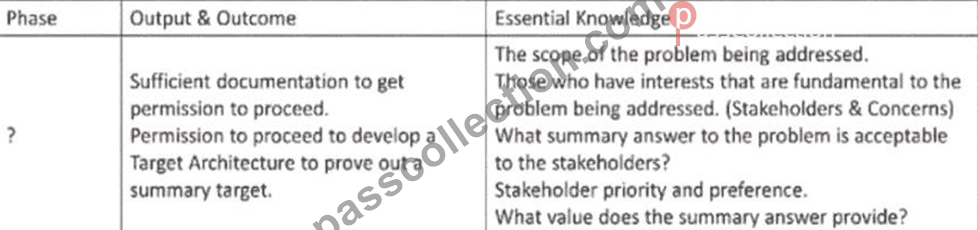
Which ADM Phase does this describe?
- A. Preliminary Phase
- B. Phase A
- C. Phase C
- D. Phase B
Answer: D
Explanation:
Phase B of the ADM cycle is the Business Architecture phase. It describes the development of a Business Architecture to support an agreed Architecture Vision. The objectives of this phase are to describe the baseline and target Business Architecture, identify candidate Architecture Roadmap components based on gaps between the baseline and target, and determine whether an incremental approach is required. Reference:
The TOGAF Standard | The Open Group Website, Section 3.2.2 Phase B: Business Architecture.
NEW QUESTION # 98
The_________________ensures that a project transitioning into implementation also smoothly transitions into appropriate Architecture Governance.
- A. Implementation Strategy
- B. Implementation Governance Model
- C. Migration Plan
- D. Transition Plan
Answer: B
Explanation:
The Implementation Governance Model is a framework that defines the roles, responsibilities, processes, and standards for governing the implementation of the target architecture. It ensures that a project transitioning into implementation also smoothly transitions into appropriate Architecture Governance, which is the practice of ensuring compliance with the enterprise architecture and its principles, standards, and goals. The Implementation Governance Model is part of the Implementation and Migration Plan, which is the output of Phase F: Migration Planning of the Architecture Development Method (ADM)12 Reference: 1: The TOGAF Standard, Version 9.2, Part II: Architecture Development Method (ADM), Chapter 21: Phase F: Migration Planning 2: The TOGAF Standard, Version 9.2, Part VI: Architecture Capability Framework, Chapter 50: Architecture Governance
NEW QUESTION # 99
Please read this scenario prior to answering the question
You are employed as an Enterprise Architect for a company that supplies products for industrial productionautomation. You are part of an Enterprise Architecture (EA) team that has responsibilities across thecompany.
The company has multiple manufacturing plants where it assembles both standard and customizedproducts.
Each of these plants operates its own planning and production scheduling systems, as well asapplications and control systems that drive the automated production line.
During a recent management meeting, the agenda included discussion of how a competitor company hadimproved production efficiency by replacing multiple planning and scheduling systems with a single cloud-based system. This had reduced lifecycle costs through reduced duplication, lowered software maintenancecosts, and supported incremental replacement. The CIO claimed the company's current systemsarchitecture is already optimized. However, as the competitor has reported better financial results, the CEOhas requested an investigation of a cloud-based solution.
In response, the Architecture Board approved a Request for Architecture Work to find out if such anarchitecture transformation would lead to efficiency improvements. You have been asked to help thearchitecture team with this project.
A concern of the plant managers is the safety and dependability of using a remote centralized system forplanning and scheduling production. The system they choose must also be able to work with the localpartners in the supply chain at each plant.
The company has an Enterprise Architecture (EA) practice and uses the TOGAF standard as the basis for itswork. It has been running for many years and has established governance and development processes forEA. The Chief Information Officer (CIO) sponsors the Enterprise Architecture program.
Refer to the scenario
You have been asked to describe how you will start the architecture project.
Based on the TOGAF standard, which of the following is the best answer?
- A. You would run a series of interviews at each manufacturing plant to discover and document businessrequirements. This would also help you understand the systems and integrations with local partners.You would create a matrix of stakeholders and their primary concerns. You would then determineand record the main stakeholder requirements for the architecture. You would then create clear high-level descriptions of the current and future architectures.
- B. You would gather information from your suppliers and conduct a series of briefings with those of themthat are on the current approved supplier list. Based on the findings from the research, you woulddefine a preliminary Architecture Vision including summary views, high-level requirements, and high-level definitions of the baseline and target environments from a business, information systems, andtechnology perspective. You would then use the Architecture Vision to build agreement among thekey stakeholders.
- C. You would develop baseline and target Architectures for each manufacturing plant, ensuring that theviews corresponding to selected viewpoints address key concerns of the stakeholders. A businesscase, together with performance metrics and measures should be defined to ensure the architecturemeets the business needs. A consolidated gap analysis between the architectures will then validatethe approach and determine the capability increments needed to achieve the target state.
- D. You would conduct a series of workshops with the local partners to gather requirements from them. Based on the findings from the workshops, you would define a preliminary Architecture Visionincluding summary views, high-level requirements, and high-level definitions of the baseline andtarget environments from a business, information systems, and technology perspective. You wouldthen use the Architecture Vision to build agreement among the local partners.
Answer: D
Explanation:
OptionAbest aligns withTOGAF Phase A: Architecture Vision, which is thestarting phasefor an architecture development cycle in TOGAF. This phase sets the foundation for the architecture engagement and ensuresalignment with stakeholders and their concerns, especially when evaluating a major transformation like moving to acloud-based planning and scheduling system.
#Key TOGAF Concepts Supporting Option A:
1. Phase A: Architecture Vision Objectives
* Establish thehigh-level scope, constraints, and expectations.
* Identify stakeholdersand define theirconcerns and business requirements.
* Create theArchitecture Vision, which includes:
* Summary-levelBaseline and Target Architectureviews (business, data, application, and technology).
* Initialrequirementsandkey concerns.
* Stakeholder buy-inand approval for moving forward.
2. Engagement with Stakeholders
* In this case, theplant managers and local supply chain partnershave concerns regarding safety and dependability.
* TOGAF emphasizes early engagement withbusiness stakeholdersto ensure concerns are identified and incorporated into the vision.
3. Creating Architecture Vision Document
* A deliverable of Phase A.
* Includeshigh-level descriptionsof the baseline and target architectures, initialbusiness goals, and stakeholder viewpoints.
* Used tobuild agreement and obtain formal approvalto proceed with detailed architecture work in later phases (B-D).
#Why Other Options Are Incorrect:
* B: Focuses onsuppliersand not theactual stakeholdersimpacted by the architecture - i.e.,plant managers and internal operations. This diverts from TOGAF's stakeholder-driven approach in Phase A).
* C: This reflectsPhases B-Dof the ADM (Business, Information Systems, and Technology Architecture). It istoo detailed and prematurefor the start of the project. In Phase A, you don't yet develop full baseline and target architectures or conduct a consolidated gap analysis.
* D: While interviewing stakeholders is valid in Phase A, this option lacks aholistic view of the Architecture Vision development, and skips the TOGAF requirement to producesummary views of the baseline and target architecturesand to use them to drive stakeholder buy-in. It istactically correct, butstrategically incomplete.
#TOGAF Source References:
* TOGAF 9.2 - Section 6.2 (Phase A: Architecture Vision)
"The Architecture Vision describes how the proposed architecture support the business goals, and the strategic direction. It also provides a high-level description of the baseline and target architectures and identifies key stakeholders and concerns."
* TOGAF 9.2 - Part IV, Architecture Content Framework
"The Architecture Vision includes the scope, constraints, and expectations. It forms the basis for approval to proceed with further architecture development."
NEW QUESTION # 100
Which of the following statements about architecture partitioning is correct?
- A. Partitions are equivalent to architecture levels.
- B. Partitions are used to simplify the management of the Enterprise Architecture.
- C. Partitions reflect the organization's structure.
- D. Partitions are defined and assigned to agile Enterprise Architecture teams.
Answer: B
Explanation:
Based on the web search results, architecture partitioning is a technique that divides the Enterprise Architecture into smaller and manageable segments or groups, based on various classification criteria, such as subject matter, time, maturity, volatility, etc.12 Architecture partitioning is used to simplify the development and management of the Enterprise Architecture, by reducing complexity, improving governance, enhancing reusability, and increasing alignment and agility12. Therefore, the statement that partitions are used to simplify the management of the Enterprise Architecture is correct.
The other statements are incorrect because:
*Partitions are not equivalent to architecture levels. Architecture levels are different layers of abstraction that describe the Enterprise Architecture from different perspectives, such as strategic, segment, and capability3.
Partitions are subsets of architectures that are defined within or across the levels, based on specific criteria1.
*Partitions do not necessarily reflect the organization's structure. The organization's structure is one possible criterion for partitioning the architecture, but it is not the only one. Other criteria, such as business function, product, service, geography, etc., can also be used to partition the architecture12.
*Partitions are not defined and assigned to agile Enterprise Architecture teams. Agile Enterprise Architecture is an approach that applies agile principles and practices to the architecture work, such as iterative development, frequent feedback, adaptive planning, and continuous delivery4. Partitions are not a specific feature of agile Enterprise Architecture, but a general technique that can be applied to any architecture method or framework, including TOGAF12.
References: 1: The TOGAF Standard, Version 9.2 - Architecture Partitioning 2: TOGAF Standard - Introduction - Architecture Partitioning 3: [The TOGAF Standard, Version 9.2 - Applying the ADM Across the Architecture Landscape] 4: TOGAF Standard - Introduction - Definitions - The Open Group
NEW QUESTION # 101
Which of the following describes the concept of an Enterprise Architecture Capability?
- A. The ability to follow general rules and guidelines that relate to Enterprise Architecture work and that enable decision-making.
- B. The ability to develop, use, and sustain the architecture of a particular enterprise using architecture to govern change.
- C. The ability to strike a balance between positive and negative outcomes resulting from the realization of opportunities.
- D. The ability to distinguish between different types of architectural assets that exist at different levels of abstraction in the enterprise.
Answer: B
Explanation:
Comprehensive and Detailed In-Depth Explanation from Expert in Enterprise Architecture, guiding in TOGAF and ArchiMate:
In TOGAF, an Enterprise Architecture Capability represents the organizational ability to effectively perform architecture work on an ongoing basis. It encompasses people, processes, governance, tools, and skills required to create and use architecture to guide enterprise change.
This capability enables the enterprise to:
Develop architectures across domains and scopes
Apply architecture consistently to guide strategy and execution
Govern change through architecture principles, standards, and compliance Sustain architecture practices over time Why Option C is correct:
Option C accurately reflects TOGAF's definition: the ability to develop, use, and sustain architecture as a means of governing enterprise change.
Why the other options are incorrect:
A describes the Enterprise Continuum, not capability.
B describes Architecture Principles, not the overall capability.
D describes risk management, not architecture capability.
Authoritative TOGAF
Reference:
TOGAF Architecture Capability Framework
TOGAF Enterprise Architecture Definition
TOGAF Architecture Governance
NEW QUESTION # 102
Which of the following is the ability to develop use and sustain the architecture of a particular enterprise using architecture to govern change?
- A. An EA framework
- B. An EA Capability
- C. An Enterprise Architecture
- D. An EA repository
Answer: B
Explanation:
The ability to develop, use, and sustain the architecture of a particular enterprise using architecture to govern change is an EA Capability. An EA Capability is a set of skills, processes, roles, responsibilities, tools, and techniques that enable an enterprise to successfully develop and maintain its Enterprise Architecture and achieve its desired outcomes. An EA Capability is part of an enterprise's overall capability portfolio and should be aligned with its strategy and objectives. Reference: The TOGAF® Standard | The Open Group Website, Section 3.2 Preliminary Phase.
NEW QUESTION # 103
Consider the following descriptions of deliverables consumed and produced across the TOGAF ADM cycle.
* General rules and guidelines, intended to be enduring and seldom
amended, that inform and support the way in which an organization sets
about fulfilling its mission
* The joint agreements between development partners and sponsors on the deliverables, quality, and fitness-for-purpose of an architecture.
* A document that is sent from the sponsoring organization to the
architecture organization to trigger the start of an architecture
development cycle
* A set of quantitative statements that outline what an implementation
project must do in order to comply with the architecture.
Which deliverables match these descriptions?
- A. 1 Architecture Requirements Specification -2 Architecture Principles - 3 Architecture Vision - 4 Architecture Contracts
- B. 1 Architecture Principles -2 Architecture Contracts - 3 Request for Architecture Work - 4 Architecture Requirements Specification
- C. 1 Architecture Principles -2 Architecture Contracts - 3 Architecture Requirements Specification-4 Request for Architecture Work
- D. 1 Architecture Contracts - 2 Architecture Requirements Specification - 3 Architecture Vision - 4 Architecture Principles
Answer: B
Explanation:
According to the TOGAF standard, the deliverables that match the descriptions are as follows:
* 1 Architecture Principles: These are general rules and guidelines, intended to be enduring and seldom amended, that inform and support the way in which an organization sets about fulfilling its mission1. They reflect a level of consensus among the various elements of the enterprise, and form the basis for making future IT decisions1.
* 2 Architecture Contracts: These are the joint agreements between development partners and sponsors on the deliverables, quality, and fitness-for-purpose of an architecture2. They are used to ensure that the architecture is implemented and governed according to the agreed-upon specifications and standards2.
* 3 Request for Architecture Work: This is a document that is sent from the sponsoring organization to the architecture organization to trigger the start of an architecture development cycle3. It defines the scope, schedule, budget, deliverables, and stakeholders of the architecture project3.
* 4 Architecture Requirements Specification: This is a set of quantitative statements that outline what an implementation project must do in order to comply with the architecture4. It defines the requirements for each architecture domain, as well as the relationships and dependencies among them4.
References: 1: Architecture Principles 2: Architecture Contracts 3: Request for Architecture Work 4: Architecture Requirements Specification
NEW QUESTION # 104
Consider the following chart: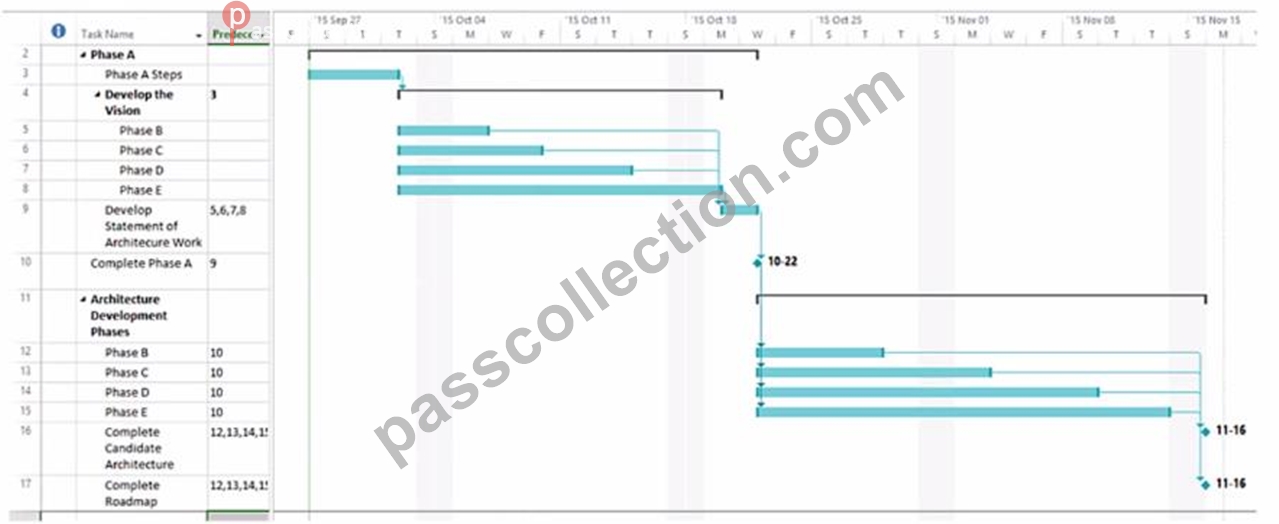
Which important concept for Enterprise Architecture Practitioners does it illustrate?
- A. Enterprise Architects must use Gantt charts to communicate with Stakeholders.
- B. ADM phases must be run in a sequenced approach to produce the Architecture.
- C. An Enterprise Architecture must be developed in phases with a limited fixed duration.
- D. ADM phases must be run simultaneously until the relevant information has been produced.
Answer: B
Explanation:
The chart shown is a Gantt chart, which is commonly used for project management to illustrate a project schedule. In the context of TOGAF (The Open Group Architecture Framework), which is a framework for enterprise architecture, this Gantt chart is demonstrating the sequenced approach to the Architecture Development Method (ADM). The ADM is the core process of TOGAF which provides a tested and repeatable process for developing architectures. The ADM is described as being iterative, over the whole process, between phases, and within phases. For each iteration of the ADM, a fresh decision must be taken about each of the parameters (scope, granularity, time period, and architecture assets).
The ADM consists of a number of phases that have to be followed in sequence:
Preliminary Phase: Framework and principles
Phase A: Architecture Vision
Phase B: Business Architecture
Phase C: Information Systems Architectures, including Data and Application Architectures Phase D: Technology Architecture Phase E: Opportunities and Solutions Phase F: Migration Planning Phase G: Implementation Governance Phase H: Architecture Change Management Requirements Management Each phase is dependent on the outputs of the previous phase and the Requirements Management phase runs throughout. The Gantt chart clearly shows the dependency and sequence in which these phases occur, implying that a structured approach is followed to produce the enterprise architecture.
Reference:
The TOGAF Standard, Version 9.2, a standard of The Open Group
The TOGAF documentation available at https://publications.opengroup.org/standards/architecture and https://publications.opengroup.org/guides/architecture
NEW QUESTION # 105
Which of the following describes the concept of an Enterprise Architecture Capability?
- A. The ability to follow general rules and guidelines that relate to Enterprise Architecture work and that enable decision-making.
- B. The ability to develop, use, and sustain the architecture of a particular enterprise using architecture to govern change.
- C. The ability to strike a balance between positive and negative outcomes resulting from the realization of opportunities.
- D. The ability to distinguish between different types of architectural assets that exist at different levels of abstraction in the enterprise.
Answer: B
Explanation:
Comprehensive and Detailed In-Depth Explanation from Expert in Enterprise Architecture, guiding in TOGAF and ArchiMate:
In TOGAF, an Enterprise Architecture Capability represents the organizational ability to effectively perform architecture work on an ongoing basis. It encompasses people, processes, governance, tools, and skills required to create and use architecture to guide enterprise change.
This capability enables the enterprise to:
* Develop architectures across domains and scopes
* Apply architecture consistently to guide strategy and execution
* Govern change through architecture principles, standards, and compliance
* Sustain architecture practices over time
Why Option C is correct:
* Option C accurately reflects TOGAF's definition: the ability to develop, use, and sustain architecture as a means of governing enterprise change.
Why the other options are incorrect:
* A describes the Enterprise Continuum, not capability.
* B describes Architecture Principles, not the overall capability.
* D describes risk management, not architecture capability.
Authoritative TOGAF References:
* TOGAF Architecture Capability Framework
* TOGAF Enterprise Architecture Definition
* TOGAF Architecture Governance
NEW QUESTION # 106
Which phase of the ADM has the purpose to develop an Enterprise Architecture Capability?
- A. Preliminary Phase
- B. Phase B
- C. Phase A
- D. Phase G
Answer: A
Explanation:
According to the TOGAF Standard, 10th Edition, the Preliminary Phase of the Architecture Development Method (ADM) has the purpose to develop an Enterprise Architecture Capability 1. An Enterprise Architecture Capability is the ability of the organization to perform the activities and tasks related to Enterprise Architecture, such as defining the scope, principles, vision, governance, and stakeholders of the architecture. The Preliminary Phase also establishes the architecture framework, the architecture repository, the architecture tools, and the architecture team 1. The other options are not correct, as they have different purposes in the ADM. Phase G: Implementation Governance has the purpose to ensure that the implementation projects conform to the target architecture 2. Phase A: Architecture Vision has the purpose to define the scope, stakeholders, business drivers, and objectives of the architecture project 3. Phase B:
Business Architecture has the purpose to describe the baseline and target business architecture, and to identify the gaps between them . References: 1: TOGAF Standard, 10th Edition, Part II: Architecture Development Method, Chapter 6: Preliminary Phase. 2: TOGAF Standard, 10th Edition, Part II: Architecture Development Method, Chapter 18: Phase G: Implementation Governance. 3: TOGAF Standard, 10th Edition, Part II:
Architecture Development Method, Chapter 12: Phase A: Architecture Vision. : TOGAF Standard, 10th Edition, Part II: Architecture Development Method, Chapter 13: Phase B: Business Architecture.
NEW QUESTION # 107
Consider the following ADM phases objectives.
Objective
1-Determine whether an incremental approach is required, and if so identify Transition Architectures that will deliver continuous business value
2-Generate the initial complete version of the Architecture Roadmap, based upon the gap analysis and candidate Architecture Roadmap components from Phases B, C, and D
3-Finalize the Architecture Roadmap and the supporting Implementation and Migration Plan
4-Ensure that the business value and cost of work packages and Transition Architectures is understood by key stakeholders Which phase does each objective match?
- A. 1E-2F-3E-4F
- B. 1F-2E-3F-4G
- C. 1E-2E-3F-4F
- D. 1G-2E-3F-4F
Answer: D
Explanation:
Explanation
According to the TOGAF standard, the objectives of each ADM phase are as follows1:
*Phase E: Opportunities and Solutions
oDetermine whether an incremental approach is required, and if so identify Transition Architectures that will deliver continuous business value oIdentify and group major work packages within the Architecture Roadmap oIdentify and group major implementation projects to realize the Architecture Roadmap oIdentify dependencies between increments and projects oEstimate cost, benefit, and risk at a high level for each increment and project oConduct initial prioritization and sequencing of the Architecture Roadmap and projects
*Phase F: Migration Planning
oGenerate the initial complete version of the Architecture Roadmap, based upon the gap analysis and candidate Architecture Roadmap components from Phases B, C, and D oConfirm the Transition Architectures with relevant stakeholders oCreate the Implementation and Migration Plan, including Transition Architectures, work packages, projects, and other activities oConfirm and agree the Architecture Roadmap and Implementation and Migration Plan with relevant stakeholders
*Phase G: Implementation Governance
oFinalize the Architecture Roadmap and the supporting Implementation and Migration Plan oEnsure conformance with the Target Architecture by implementation projects oPerform appropriate Architecture Governance functions for the solution and any implementation-driven architecture Change Requests oEnsure that the architecture lifecycle is maintained oEnsure that the Architecture Governance Framework is executed
*Phase H: Architecture Change Management
oEnsure that the business value and cost of work packages and Transition Architectures is understood by key stakeholders oManage risks and issues related to the Architecture Roadmap and Implementation and Migration Plan oMonitor the implementation projects and Transition Architectures oManage changes to the architecture baseline oManage changes to the Architecture Capability Therefore, the correct matching of the objectives and the phases is:
*1G: Determine whether an incremental approach is required, and if so identify Transition Architectures that will deliver continuous business value
*2E: Generate the initial complete version of the Architecture Roadmap, based upon the gap analysis and candidate Architecture Roadmap components from Phases B, C, and D
*3F: Finalize the Architecture Roadmap and the supporting Implementation and Migration Plan
*4F: Ensure that the business value and cost of work packages and Transition Architectures is understood by key stakeholders References: 1: The TOGAF Architecture Development Method
NEW QUESTION # 108
Consider the following ADM phases objectives.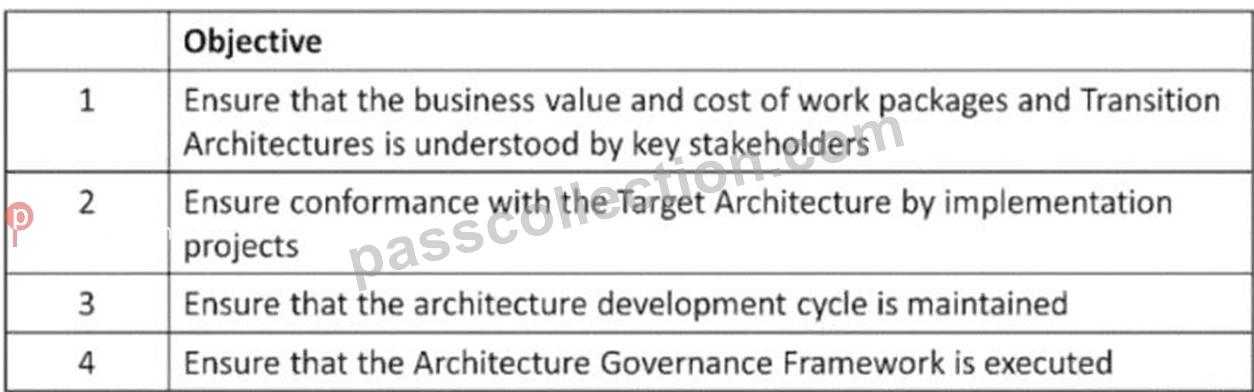
Which phase does each objective match?
- A. 1F-2G-3H-4H
- B. 1F-2G-3G-4H
- C. 1G-2H-3H-4F
- D. 1H-2F-3F-4G
Answer: D
Explanation:
* According to the TOGAF Standard, Version 9.2, the ADM phases and their objectives are as follows1:
* Preliminary Phase: To prepare and initiate the architecture development cycle, including defining the architecture framework, principles, and governance.
* Phase A: Architecture Vision: To define the scope, vision, and stakeholders of the architecture initiative, and to obtain approval to proceed.
* Phase B: Business Architecture: To describe the baseline and target business architecture, and to identify the gaps between them.
* Phase C: Information Systems Architectures: To describe the baseline and target data and application architectures, and to identify the gaps between them.
* Phase D: Technology Architecture: To describe the baseline and target technology architecture, and to identify the gaps between them.
* Phase E: Opportunities and Solutions: To identify and evaluate the opportunities and solutions for implementing the target architecture, and to define the work packages and transition architectures.
* Phase F: Migration Planning: To finalize the implementation and migration plan, and to ensure alignment with the enterprise portfolio and project management.
* Phase G: Implementation Governance: To provide architecture oversight and guidance for the implementation projects, and to manage any architecture change requests.
* Phase H: Architecture Change Management: To monitor the changes in the business and technology environment, and to assess the impact and performance of the architecture.
* Requirements Management: To manage the architecture requirements throughout the ADM cycle, and to ensure alignment with the business requirements.
* Based on the above definitions, we can match each objective with the corresponding phase as follows:
* Objective 1: Ensure that the business value and cost of work packages and transition architectures is understood by key stakeholders. This objective is achieved in Phase H: Architecture Change Management, where the value realization and cost-benefit analysis of the architecture are performed2.
* Objective 2: Ensure conformance with the Target Architecture by implementation projects. This objective is achieved in Phase F: Migration Planning, where the conformance requirements and criteria for the implementation projects are defined3.
* Objective 3: Ensure that the architecture development cycle is maintained. This objective is achieved in Phase F: Migration Planning, where the architecture roadmap and iteration cycle are maintained3.
* Objective 4: Ensure that the Architecture Governance Framework is executed. This objective is achieved in Phase G: Implementation Governance, where the architecture governance processes and procedures are applied to the implementation projects4.
References:
* 1: The TOGAF Standard, Version 9.2, Chapter 5: Architecture Development Method (ADM)
* 2: The TOGAF Standard, Version 9.2, Chapter 21: Architecture Change Management
* 3: The TOGAF Standard, Version 9.2, Chapter 20: Migration Planning
* 4: The TOGAF Standard, Version 9.2, Chapter 19: Implementation Governance
NEW QUESTION # 109
......
Free OGEA-103 Exam Files Downloaded Instantly 100% Dumps & Practice Exam: https://www.passcollection.com/OGEA-103_real-exams.html
Updated Verified OGEA-103 dumps Q&As - 100% Pass Guaranteed: https://drive.google.com/open?id=1TYVx_FhmJdFWHGvSDhGJ9iQqpAZ0hN4j
