

Get Real 350-401 Quesions Pass Cisco Certification Exams Easily
350-401 Dumps are Available for Instant Access
NEW QUESTION # 232
Refer to the exhibit.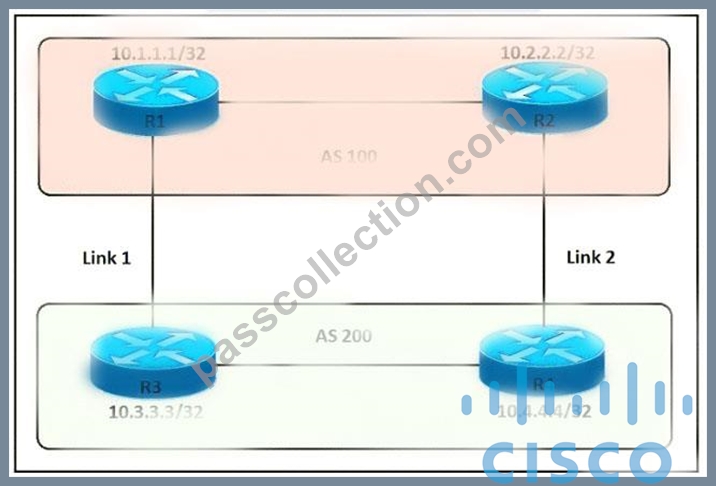
An engineer must ensure that all traffic leaving AS 200 will choose Link 2 as the exit point. Assuming that all BGP neighbor relationships have been formed and that the attributes have not been changed on any of the routers, which configuration accomplish task?
- A. R4(config-router)bgp default local-preference 200
- B. R3(config-router)bgp default local-preference 200
- C. R4(config-router)nighbor 10.2.2.2 weight 200
- D. R3(config-router)neighbor 10.1.1.1 weight 200
Answer: A
Explanation:
Explanation
Local preference is an indication to the AS about which path has preference to exit the AS in order to reach a certain network. A path with a higher local preference is preferred. The default value for local preference is 100.
Unlike the weight attribute, which is only relevant to the local router, local preference is an attribute that routers exchange in the same AS. The local preference is set with the "bgp default local-preference value" command.
In this case, both R3 & R4 have exit links but R4 has higher local-preference so R4 will be chosen as the preferred exit point from AS 200.
NEW QUESTION # 233
Drag and drop the characteristics from the left onto the correct infrastructure deployment types on the right.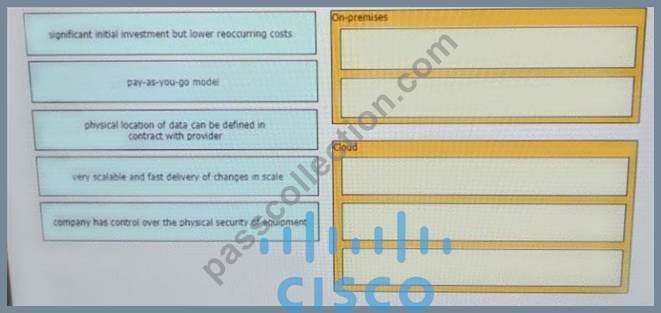
Answer:
Explanation: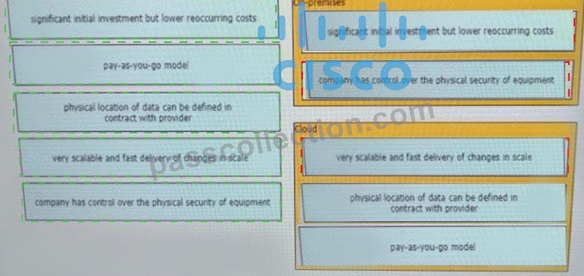
Explanation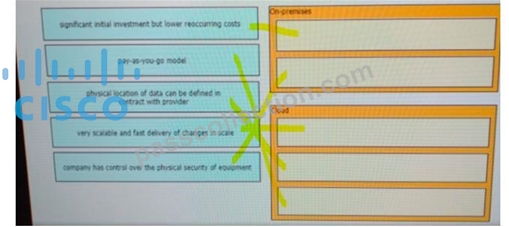
NEW QUESTION # 234
A network administrator applies the following configuration to an IOS device.
What is the process of password checks when a login attempt is made to the device?
- A. A local database is checked first. If that check fails, a TACACS+server is checked.
- B. A TACACS+server is checked first. If that check fail, a database is checked?
- C. A TACACS+server is checked first. If that check fail, a RADIUS server is checked. If that check fail. a local database is checked.
- D. A local database is checked first. If that fails, a TACACS+server is checked, if that check fails, a RADUIS server is checked.
Answer: C
Explanation:
The configuration lines provided indicate the use of AAA (Authentication, Authorization, and Accounting) with a default login authentication method list named "default". This list specifies the sequence of authentication methods to be queried during login attempts. The keyword 'group' followed by 'tacacs+' indicates that the device should first attempt to use TACACS+ for authentication. If TACACS+ servers are unreachable or unable to authenticate the user, the next method specified is 'radius', which means it will then attempt to use RADIUS for authentication. Finally, if both TACACS+ and RADIUS fail, 'local' indicates that the device should fall back on its local user database for authentication.
NEW QUESTION # 235
Drag and drop the descriptions from the left onto the routing protocol they describe on the right.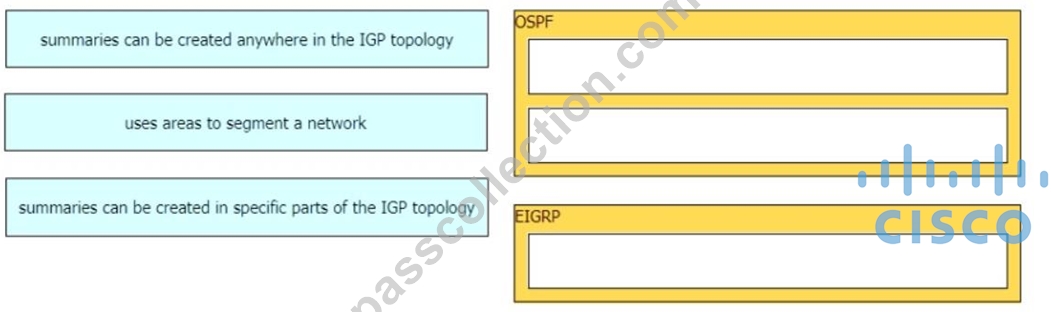
Answer:
Explanation: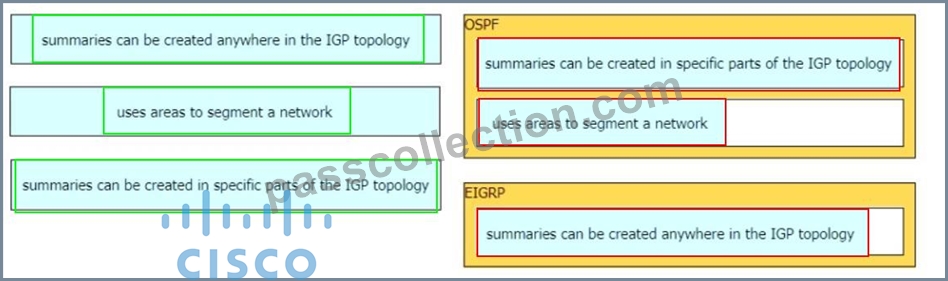
NEW QUESTION # 236
Refer to the exhibit. An engineer is reaching network 172.16.10.0/24 via the R1-R2-R4 path.
Which configuration forces the traffic to take a path of R1-R3-R4?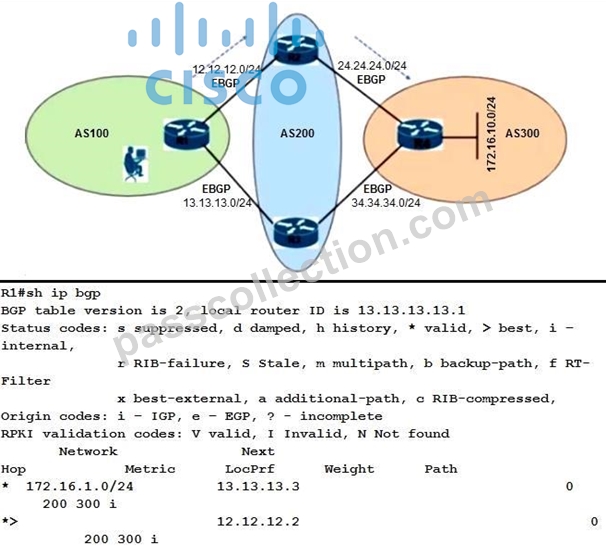
- A. R1(config)#router bgp 100
R1(config-router)#neighbor 13.13.13.3 weight 1
R1(config-router)#end - B. R2(config)#route-map RM_MED permit 10
R2(config-route-map)#set metric 1
R2(config-route-map)#exit
R2(config)#router bgp 200
R2(config-router)#neighbor 12.12.12.1 route-map RM_MED out
R2(config-router)#end
R2#clear ip bgp 12.12.12.1 soft out - C. R1(config)#route-map RM_LOCAL_PREF permit 10
R1(config-route-map)#set local-preference 101
R1(config-route-map)#exit
R1(config)#router bgp 100
R1(config-router)#neighbor 13.13.13.3 route-map RM_LOCAL_PREF in
R1(config-router)#end
R1#clear ip bgp 13.13.13.3 soft in - D. R1(config)#route-map RM_AS_PATH_PREPEND
R1(config-route-map)#set as-path prepend 200 200
R1(config-route-map)#exit
R1(config)#router bgp 100
R1(config-router)#neighbor 12.12.12.2 route-map RM_AS_PATH_PREPEND in
R1(config-router)#end
R1#clear ip bgp 12.12.12.2 soft in
Answer: C
Explanation:
https://community.cisco.com/t5/networking-documents/understanding-bgp-best-path-selection- manipulation/ta-p/3150576
NEW QUESTION # 237
the following system log message is presented after a network administrator configures a GRE tunnel:
%TUN-5-RECURDOWN Interface Tunnel 0 temporarily disabled due to recursive routing
Why is tunnel 0 disabled?
- A. Because the tunnel cannot reach its tunnel destination
- B. Because dynamic routing is not enabled
- C. Because the best path to the tunnel destination is through the tunnel itself
- D. Because the router cannot recursively identify its egress forwarding interface
Answer: C
NEW QUESTION # 238
Refer to the exhibit. Which configuration enables fallback to local authentication and authorization when no TACACS+ server is available?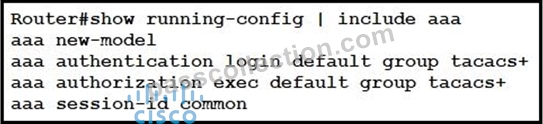
- A. Router(config)# aaa fallback local
- B. Router(config)# aaa authentication login FALLBACK local
Router(config)# aaa authorization exec FALLBACK local - C. Router(config)# aaa authentication login default local
Router(config)# aaa authorization exec default local - D. Router(config)# aaa authentication login default group tacacs+ local Router(config)# aaa authorization exec default group tacacs+ local
Answer: D
NEW QUESTION # 239
The Overlay Management Protocol (OMP) is used as the control plane protocol and forms peers between the VSmart Controller and the SD-WAN edge devices. OMP is responsible for advertising which three types of routes in the SD-WAN network? (Choose three.)
- A. OMP routes
- B. LISP routes
- C. TLOCs
- D. MP-BGP
- E. Service routes
Answer: A,C,E
Explanation:
https://www.cisco.com/c/en/us/td/docs/routers/sdwan/configuration/policies/vedge/policies- book/control-policies.html
NEW QUESTION # 240
Drag and drop the characteristics from the left onto the technology types on the right.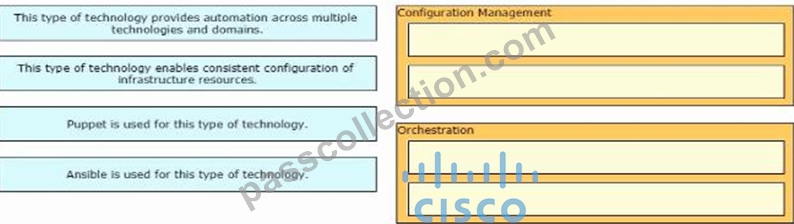
Answer:
Explanation: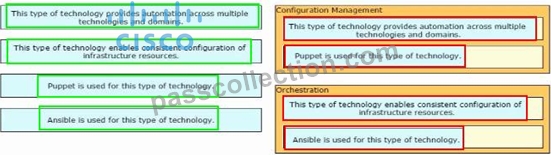
NEW QUESTION # 241
Refer to the exhibit.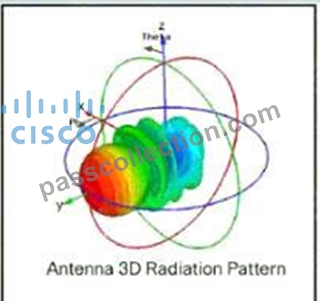
Which type of antenna does the radiation pattern represent?
- A. directional patch
- B. multidirectional
- C. Yagi
- D. omnidirectional
Answer: C
Explanation:
Explanation
A Yagi antenna is formed by driving a simple antenna, typically a dipole or dipolelike antenna, and shaping the beam using a well-chosen series of non-driven elements whose length and spacing are tightly controlled.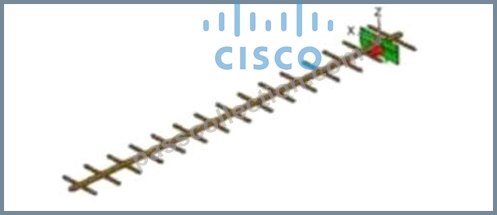
NEW QUESTION # 242
What are two benefits of implementing a Cisco SD-WAN architecture? (Choose two)
- A. It enforces a single. scalable. hub-and-spoke topology.
- B. It provides resilient and effective traffic flow using MPLS.
- C. It simplifies endpoint provisioning through standalone router management
- D. It allows configuration of application-aware policies with real time enforcement.
- E. It improves endpoint protection by integrating embedded and cloud security features.
Answer: D,E
Explanation:
Implementing a Cisco SD-WAN architecture offers several advantages, particularly in terms of security and application-aware networking.
* Security Integration: Cisco SD-WAN integrates both embedded and cloud security features, enhancing endpoint protection. This integration allows for a more robust security posture that can adapt to the evolving threat landscape. The architecture transforms Cisco routers into advanced security devices with an enterprise firewall, intrusion prevention system (IPS), URL filtering, and continuous DNS monitoring, ensuring end-to-end protection.
* Application-Aware Policies: Cisco SD-WAN enables the configuration of application-aware policies that are enforced in real-time. This capability ensures that critical applications receive the necessary bandwidth and performance, even in complex network environments. It allows for intelligent path selection based on the application's needs, improving overall application performance and user experience.
NEW QUESTION # 243
Which function does a fabric wireless LAN controller perform In a Cisco SD-Access deployment?
- A. manages fabric-enabled APs and forwards client registration and roaming information to the Control Plane Node
- B. is dedicated to onboard clients in fabric-enabled and nonfabric-enabled APs within the fabric
- C. performs the assurance engine role for both wired and wireless clients
- D. coordinates configuration of autonomous nonfabric access points within the fabric
Answer: A
Explanation:
Explanation
Fabric Enabled WLC:
Fabric enabled WLC is integrated with LISP control plane. This WLC is responsible for AP image /Config, Radio Resource Management, Client Session management and roaming and all other wireless control plane functions.
For WLC Fabric Integration:
* Wireless Client MAC address is used as EID
* It inform about Wireless MAC address with its other information like SGT and Virtual Network Information
* VN information is mapped to VLAN on FEs
* WLC is responsible for updating Host Database tracking DB with roaming information
https://www.cisco.com/c/en/us/td/docs/solutions/CVD/Campus/cisco-sda-design-guide.html#FabricWLC Both fabric WLCs and non-fabric WLCs provide AP image and configuration management, client session management, and mobility services. Fabric WLCs provide additional services for fabric integration such as registering MAC addresses of wireless clients into the host tracking database of the fabric control plane nodes during wireless client join events and supplying fabric edge node RLOC-association updates to the HTDB during client roam events.
NEW QUESTION # 244 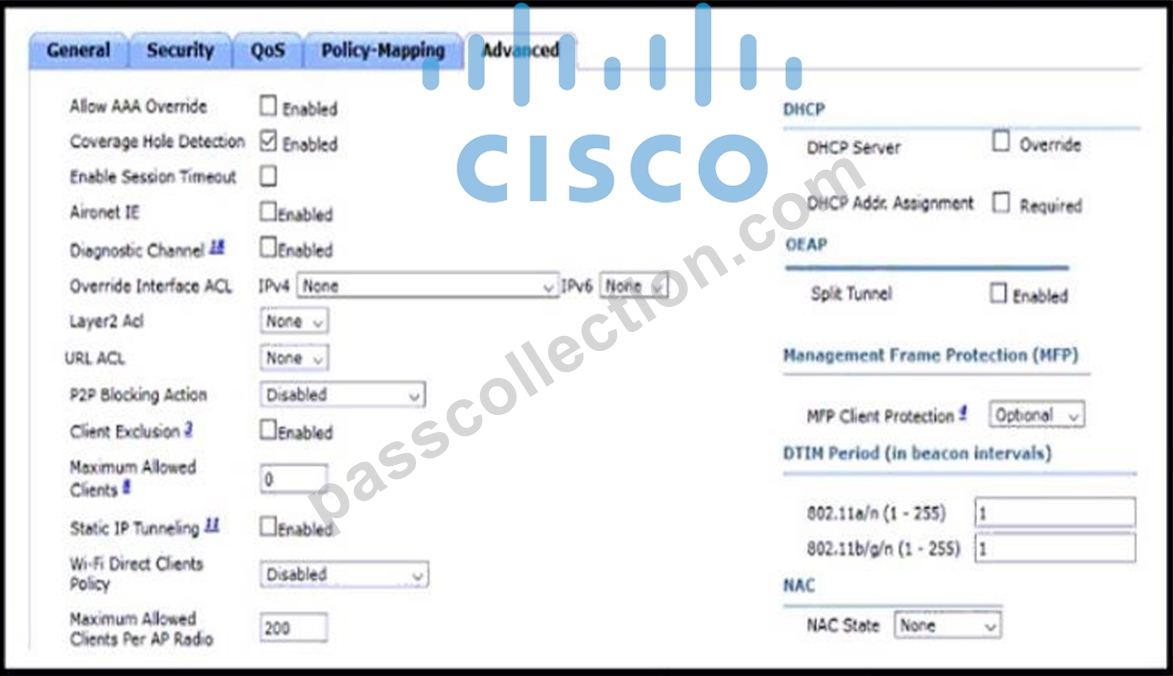
Refer to the exhibit. An engineer is investigating why guest users are able to access other guest user devices when the users are connected to the customer guest WLAN. What action resolves this issue?
- A. implement MFP client protection
- B. implement P2P blocking
- C. implement Wi-Fi direct policy
- D. implement split tunneling
Answer: C
Explanation:
Explanation
https://www.cisco.com/c/en/us/td/docs/wireless/controller/8-1/configurationguide/b_cg81/b_cg81_chapter_0100
NEW QUESTION # 245
Which controller is the single plane of management for Cisco SD-WAN?
- A. vBond
- B. vManage
- C. vSmart
- D. vEdge
Answer: B
Explanation:
The primary components for the Cisco SD-WAN solution consist of the vManage network management system (management plane), the vSmart controller (control plane), the vBond orchestrator (orchestration plane), and the vEdge router (data plane).
+ vManage - This centralized network management system provides a GUI interface to easily monitor, configure, and maintain all Cisco SD-WAN devices and links in the underlay and overlay network.
+ vSmart controller - This software-based component is responsible for the centralized control plane of the SD-WAN network. It establishes a secure connection to each vEdge router and distributes routes and policy information via the Overlay Management Protocol (OMP), acting as a route reflector. It also orchestrates the secure data plane connectivity between the vEdge routers by distributing crypto key information, allowing for a very scalable, IKE-less architecture.
+ vBond orchestrator - This software-based component performs the initial authentication of vEdge devices and orchestrates vSmart and vEdge connectivity. It also has an important role in enabling the communication of devices that sit behind Network Address Translation (NAT).
+ vEdge router - This device, available as either a hardware appliance or software-based router, sits at a physical site or in the cloud and provides secure data plane connectivity among the sites over one or more WAN transports. It is responsible for traffic forwarding, security, encryption, Quality of Service (QoS), routing protocols such as Border Gateway Protocol (BGP) and Open Shortest Path First (OSPF), and more.
Reference:
2018OCT.pdf
NEW QUESTION # 246
Which two operational models enable an AP to scan one or more wireless channels for rouge access points and at the same time provide wireless services to clients? (Choose two.)
- A. Local
- B. Sniffer
- C. FlexConnect
- D. Rouge detector
- E. Monitor
Answer: C,E
Explanation:
FlexConnect is a wireless solution for branch office and remote office deployments. It allows access points (APs) to switch client data traffic locally and perform client authentication locally when their connection to the controller is interrupted. In FlexConnect mode, APs can also perform scanning for rogue devices.
Monitor mode enables APs to scan the environment and listen for rogue APs without serving clients. This mode dedicates the AP for monitoring purposes, which can be useful for security and troubleshooting.
NEW QUESTION # 247
Refer to the exhibit.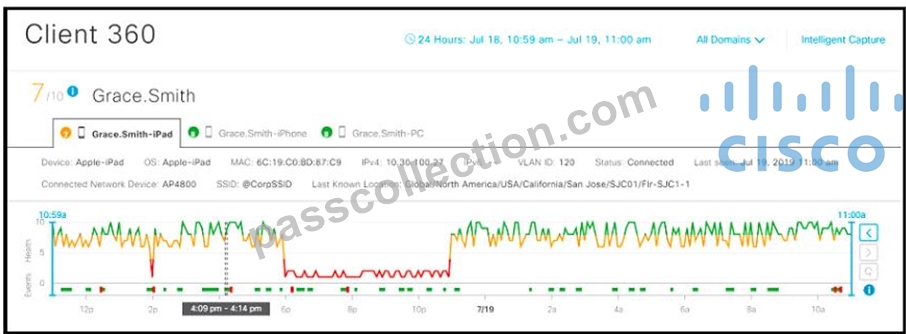
Cisco DNA Center has obtained the username of the client and the multiple devices that the client is using on the network. How is Cisco DNA Center getting these context details?
- A. Cisco DNA Center pulled those details directly from the edge node where the user connected.
- B. Those details are provided to Cisco DNA Center by the Identity Services Engine
- C. The administrator had to assign the username to the IP address manually in the user database tool on Cisco DNA Center.
- D. User entered those details in the Assurance app available on iOS and Android devices
Answer: A
Explanation:
Features of the Cisco DNA Assurance solution includes Device 360 and client 360, which provides a detailed view of the performance of any device or client over time and from any application context. Provides very granular troubleshooting in seconds.
NEW QUESTION # 248
Refer to the exhibit.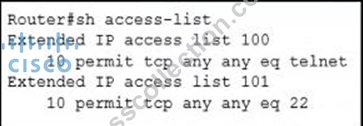
Refer to the exhibit. Which configuration set implements Control plane Policing for SSH and Telnet?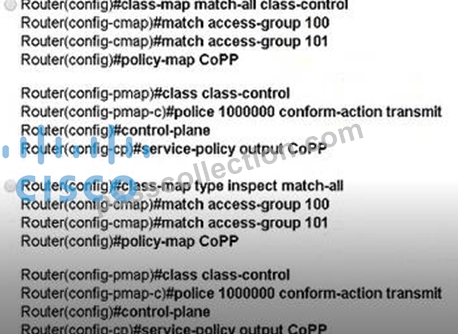
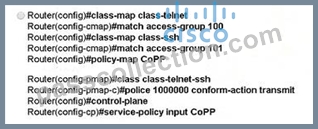
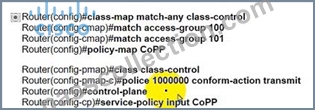
- A. Option D
- B. Option C
- C. Option B
- D. Option A
Answer: A
NEW QUESTION # 249
......
Get Instant Access REAL 350-401 DUMP Pass Your Exam Easily: https://www.passcollection.com/350-401_real-exams.html
Practice with these 350-401 dumps Certification Sample Questions: https://drive.google.com/open?id=13IcywXOg9h1Fy56EiidxaC7a5tot2Hzy
