

Check the Available Network-Security-Essentials Exam Dumps with 60 QA's UPDATED 2026
Download Network-Security-Essentials Exam Dumps Questions to get 100% Success in WatchGuard
NEW QUESTION # 19
Your network was the target of an attack last week. You want to learn more about the source of the attack.
What monitoring tools can you use to get started? (Select one.)
- A. Traffic Monitor in Firebox System Manager
- B. FireWatch in Fireware Web UI
- C. Log Search and reports in WatchGuard Cloud or Dimension
- D. WatchGuard Log Catalog
- E. Discovery in Fireware Web UI
Answer: C
Explanation:
To investigate an attack and learn more about the source,Log Search and reports in WatchGuard Cloud or Dimensionoffer detailed logs and analytical reports. These tools provide historical data, allowing you to review traffic, pinpoint the source of the attack, and analyze patterns.
While other tools like Traffic Monitor or FireWatch offer real-time monitoring, they do not provide the in- depth historical analysis and reporting features required for post-incident investigation.
NEW QUESTION # 20
With the policies configured as shown in this image, HTTP traffic can be sent and received through Branch Office VPN tunnel 1 and tunnel 2.
- A. False
- B. True
Answer: B
Explanation:
The image shows firewall policies allowing HTTP traffic throughBranch Office VPN (BOVPN)tunnel 1 and tunnel 2:
* tunnel1-http.outpolicy: Allows HTTP traffic (TCP port 80) fromAnysource totunnel 1.
* tunnel1-http.inpolicy: Allows HTTP traffic fromtunnel 1toAnydestination.
* BOVPN-Allow.outandBOVPN-Allow.inpolicies: Configured to allowAnytraffic betweentunnel 2and tunnel 1in both directions.
These configurations indicate that HTTP traffic is permitted through both tunnels, enabling it to be sent and received across BOVPN tunnels 1 and 2. Thus, users on either end of these VPN tunnels can transmit HTTP traffic successfully.
NEW QUESTION # 21
Users cannot download a PDF file from your intranet. You know the file is safe to download. When you review the log messages, you see that IntelligentAV identified the file as malicious. The only way to resolve this is to change the file extension.
- A. True
- B. False
Answer: B
Explanation:
When IntelligentAV identifies a file as malicious, users have options other than changing the file extension to resolve the issue. IntelligentAV relies on AI-driven detection, and if the PDF file isknown to be safe, an administrator can manually adjust the IntelligentAV settings or add an exception for the specific file.
Changing the file extension alone does not address the root of the detection and is not a reliable solution to bypass IntelligentAV checks.
NEW QUESTION # 22
Match each type of NAT with the correct descriptor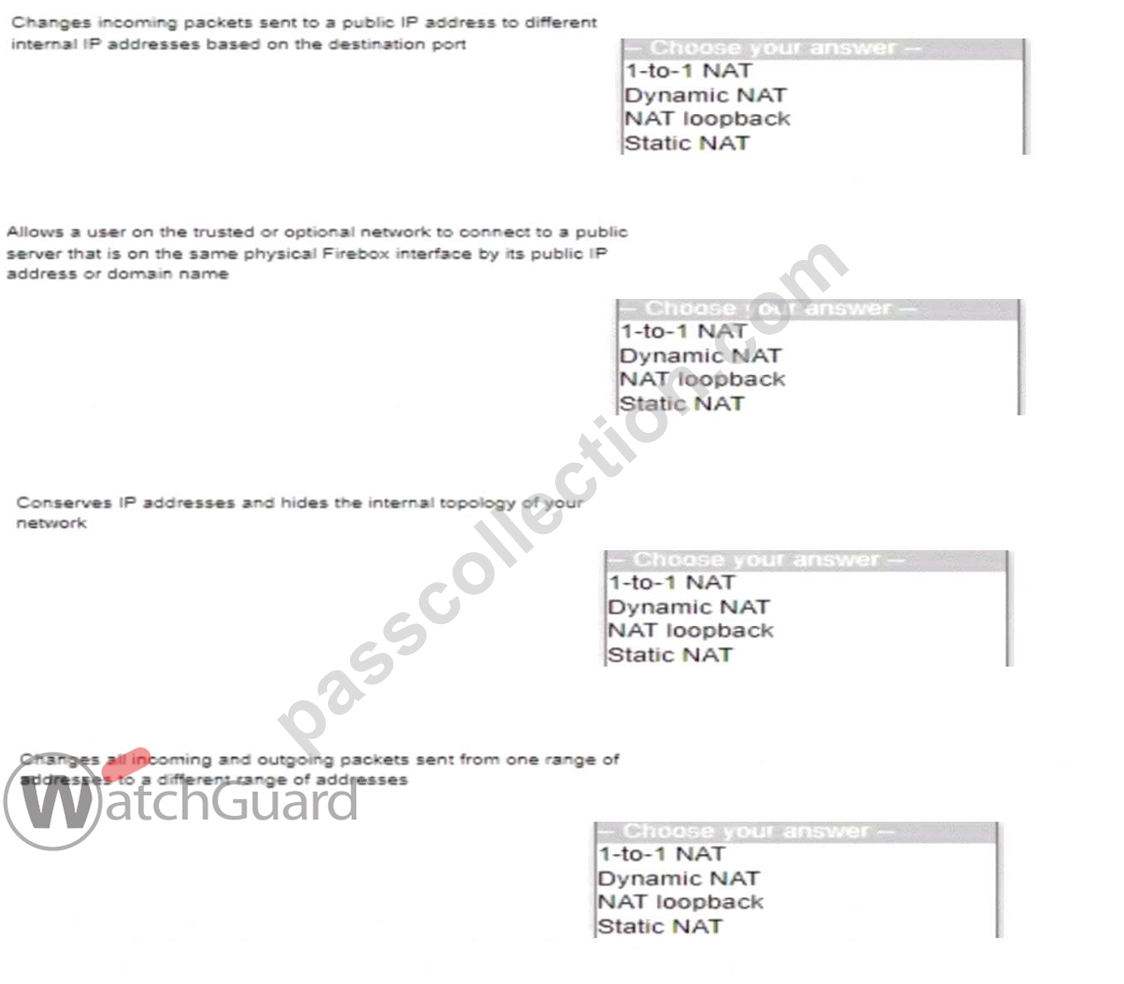
Answer:
Explanation: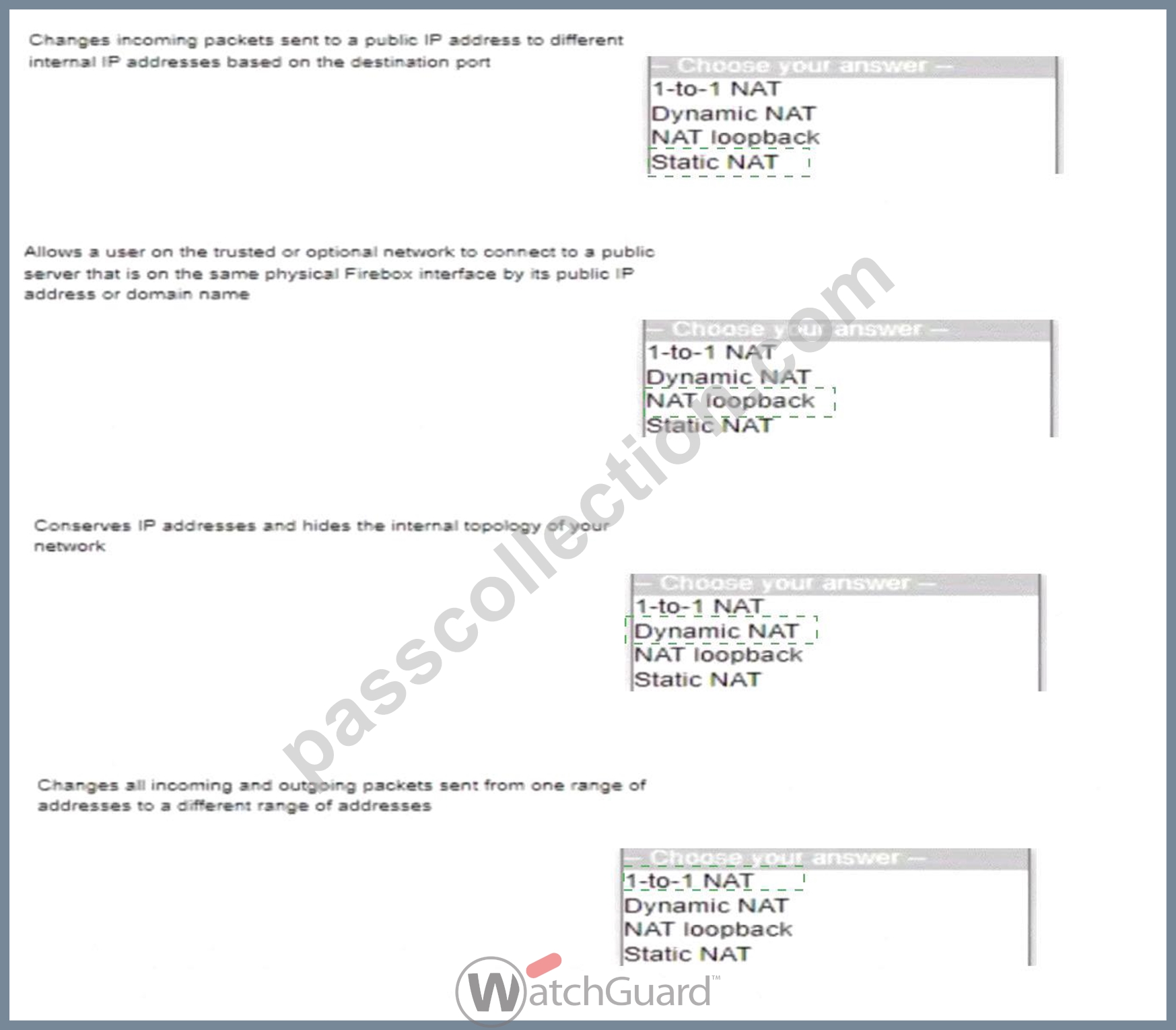
Explanation: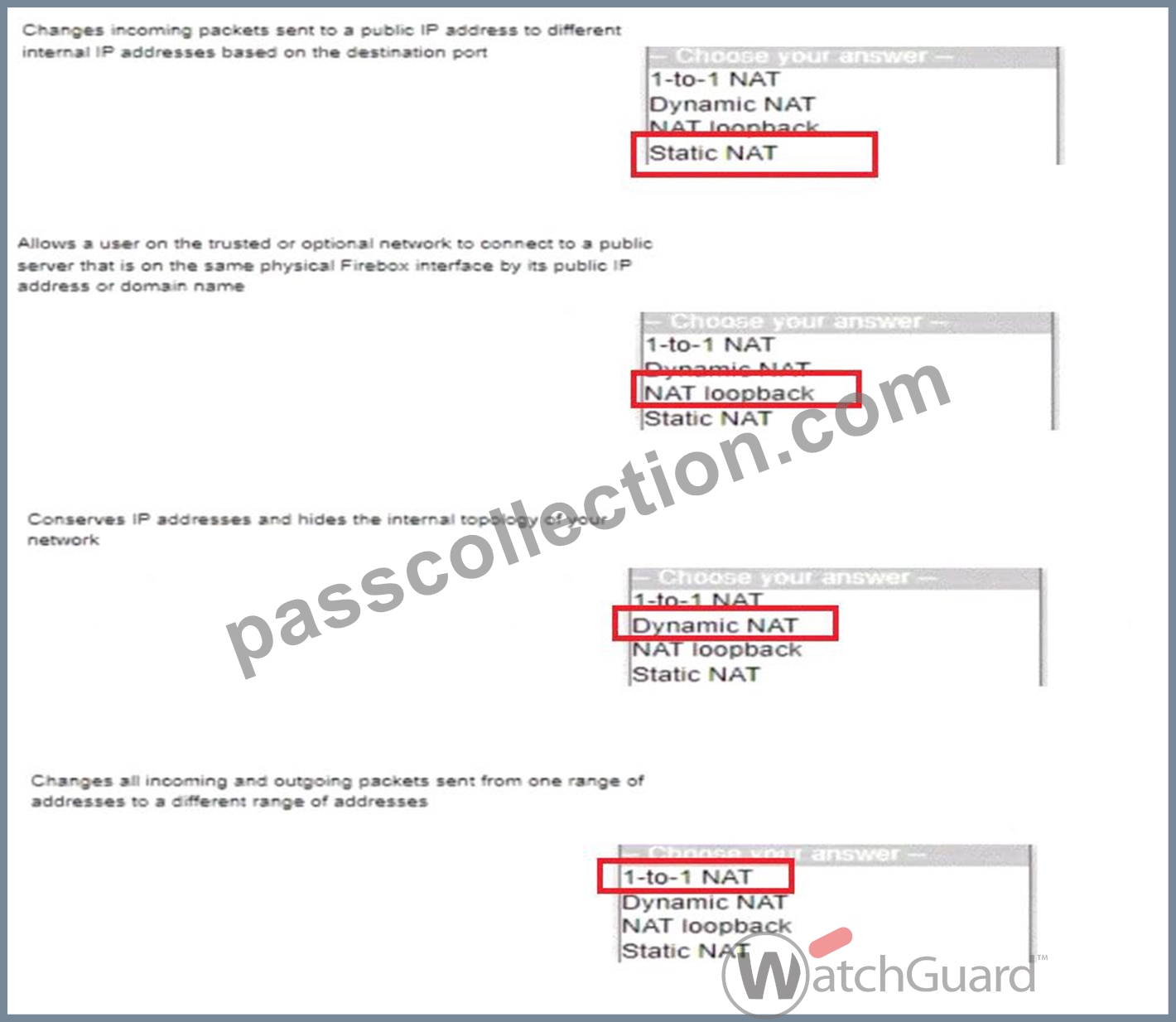
Here are the correct answers for matching each NAT type with its descriptor:
* Changes incoming packets sent to a public IP address to different internal IP addresses based on the destination portanswer:Static NAT Explanation: Static NAT maps a public IP address to multiple internal IP addresses based on the port, allowing specific services or applications to be routed to various internal destinations.
* Allows a user on the trusted or optional network to connect to a public server that is on the same physical Firebox interface by its public IP address or domain nameanswer:NAT loopback Explanation: NAT loopback (or NAT reflection) allows internal users to access a public IP address or domain name that resolves to the same local network, making it appear as if they are connecting from outside the network.
* Conserves IP addresses and hides the internal topology of your networkanswer:Dynamic NAT Explanation: Dynamic NAT (or PAT - Port Address Translation) conserves public IP addresses by allowing multiple internal devices to share a single public IP address. This setup is commonly used for outbound internet connections from a private network.
* Changes all incoming and outgoing packets sent from one range of addresses to a different range of addressesanswer:1-to-1 NAT Explanation: 1-to-1 NAT maps each internal IP address to a unique public IP address, providing a one-to-one relationship. This type of NAT is often used for networks that require external access to specific internal resources.
NEW QUESTION # 23
The Audit Trail report shows information about Firebox configuration changes. How can you makesure the Audit Trail report includes the names of the specific person that made each change? (Select one.)
- A. Enable the Logging > AuditTrack feature
- B. Create unique device administrator accounts for each Firebox administrative user
- C. Install the SSO Client on each computer used by Firebox administrators
- D. Configure all Firebox administrators to use the Authentication Portal to log in to the Firebox
- E. Configure your RADIUS server to send accounting messages to the Firebox
Answer: B
Explanation:
To ensure that the Audit Trail report in Firebox includes the specific names of administrators making configuration changes, it is essential to have unique device administrator accounts. This setup allows each administrative action to be associated with a specific user, enabling detailed tracking of configuration modifications. By differentiating user accounts, the system can log the specific username associated with each change, fulfilling audit and compliance requirements.
NEW QUESTION # 24
To accurately detect applications over an HTTPS connection with Application Control, you must enable content inspection in the HTTPS proxy.
- A. False
- B. True
Answer: B
Explanation:
For Application Control to accurately detect and manage applications over HTTPS connections, content inspection must be enabled in the HTTPS proxy. This is because HTTPS encrypts application traffic, making it unreadable without decryption. By enabling content inspection, the HTTPS proxy can inspect and classify the application traffic within HTTPS sessions, allowing Application Control to function effectively on secure connections.
NEW QUESTION # 25
After you enable content inspection, your users cannot connect to the business-critical website www.example.
com/account.html hosted by a trusted partner. To try to resolve this issue, you added a Domain Name exception of www.example.com/account.html, but users still cannot connect to the website. What is the Domain Name exception format to add to the HTTP proxy to correctly resolve this issue? (Select two.)
- A. *.example.com
- B. /account.html
- C. /example.com/
- D. example.com/
- E. www.example.com
Answer: A,E
Explanation:
When using domain exceptions to bypass content inspection for specific websites on a Firebox, the format is critical. For the domain www.example.com/account.html, two viable exception formats are:
* A. *.example.com: This wildcard format will include all subdomains of example.com, covering www.
example.com as well as any other subdomains like api.example.com. This format is useful when you need to exclude an entire domain and its subdomains from content inspection.
* D. www.example.com: This specifies the exact domain. Adding this as an exception will directly match www.example.com, making it suitable for bypassing content inspection on that specific subdomain.
Other formats, like /example.com/ or /account.html, do not match the required structure for domain name exceptions in the Firebox HTTP proxy settings.
NEW QUESTION # 26
In a Mobile VPN configuration, why would you choose default-route (full tunnel) VPN instead of split tunnel VPN? (Select one.)
- A. Default-route VPN uses less processing power.
- B. Default-route VPN uses less bandwidth.
- C. Default-route VPN is the only option you can use to apply security services to connections routed to your internal servers.
- D. Default-route VPN automatically allows dynamic NAT.
- E. Default-route VPN enables your Firebox to examine all remote user traffic.
Answer: E
Explanation:
In a Mobile VPN setup, adefault-route (full tunnel)VPN routes all of a remote user's internet traffic through the VPN tunnel to the Firebox. This configuration allows the Firebox to inspect and apply security policies to all traffic, including traffic that is not destined for internal network resources. In contrast, asplit tunnel VPN would route only traffic meant for the internal network through the VPN, while internet-bound traffic would bypass the Firebox, potentially exposing it to threats and limiting the Firebox's ability to inspect all traffic.
NEW QUESTION # 27
As you troubleshoot a Branch Office VPN tunnel, you see the log message below. Which settings can you modify in the BOVPN virtual interface configuration to resolve this issue? (Select one.)
- A. VPN Routes
- B. Gateway Settings
- C. BOVPN-Allow policies
- D. Phase 1 Settings
- E. Phase 2 Settings
Answer: E
Explanation:
When troubleshooting a Branch Office VPN (BOVPN) tunnel, issues in thePhase 2 settingscan commonly cause connectivity problems. Adjusting settings such as the encryption and integrity algorithms, or setting correct lifetimes in Phase 2, may resolve compatibility or timeout issues with third-party VPN endpoints. This configuration ensures the two VPN endpoints can securely exchange data in alignment with each other's capabilities and settings.
NEW QUESTION # 28
You configured a Firebox for a school environment. Students must have more restricted access than teachers, and unauthenticated users cannot have any Internet access. You added Student and Teacher groups to your proxy policies that handle web traffic. Based on the image below, this configuration can accomplish your goals.
- A. False
- B. True
Answer: B
Explanation:
The image shows a configuration for a school environment with separateHTTPandHTTPS proxy policiesfor StudentsandTeachers. This separation allows for different levels of access control based on group membership, providing more restrictive access for students compared to teachers.
* Studentsare restricted by specific HTTP and HTTPS proxy policies, limiting their access to designated content and sites.
* Teachershave their own policies, which can be configured with more permissive rules.
* Unauthenticated users are not included in any policy, effectively blocking their internet access, as the firewall denies traffic not explicitly allowed by a policy.
This configuration meets the requirements by:
* Allowing teachers and students access as per their respective policies.
* Blocking unauthenticated users from internet access entirely.
NEW QUESTION # 29
You have five public IP addresses available from your ISP. When you create a Static NAT action, you want to specify one of the public IP addresses for inbound traffic but do not see it in the IP address drop-down list.
How can you change the Firebox configuration to see additional public IP addresses in the Static NAT action?
(Select one.)
- A. Add the IP addresses to the Dynamic NAT configuration
- B. Add the public IP addresses to the From field of the policy that uses the Static NAT action
- C. Configure 1-to-1 NAT for your entire subnet
- D. Add secondary IP addresses to the external interface
- E. Enable the Set Source IP option in the policy
Answer: D
Explanation:
To use additional public IP addresses in a Static NAT action, you need to add them as secondary IP addresses to the external interface on the Firebox. By adding these IPs as secondary addresses, they become selectable options in the Static NAT configuration, allowing inbound traffic to be routed based on specific public IPs allocated by the ISP.
NEW QUESTION # 30
Based on the configuration shown in this image, clients on the network can successfully connect tohttps://www.watchguard.com.
- A. False
- B. True
Answer: B
Explanation:
Based on the configuration shown in the image, the HTTPS-proxy-out policy allows traffic fromAny-Trusted andAny-Optionalnetworks toAny-Externaldestination on port443(which is the standard port for HTTPS).
This rule effectively permits outbound HTTPS connections from clients within the trusted network to external HTTPS websites, such as https://www.watchguard.com.
Since the policy type isHTTPS-proxy, it can inspect and manage HTTPS traffic according to configured policies, but it does not block the connection itself. Therefore, users on the network should be able to successfully connect to external HTTPS sites.
NEW QUESTION # 31
After you enable content inspection, your users see a certificate warning when they browse the Internet. What is one way to resolve this? (Select one.)
- A. Import a trusted web server certificate to the Firebox
- B. Install the current Firebox Proxy Authority certificate on your user workstations
- C. Configure the HTTPS proxy policy to allow inbound traffic from your CA
- D. Configure a WebBlocker exception for your certificate server
Answer: B
Explanation:
When content inspection is enabled on a Firebox, it decrypts HTTPS traffic for inspection, which requires presenting its own certificate to the client devices. This often causes certificate warnings in web browsers because the certificate issued by the Firebox is not inherently trusted by the client browsers. To resolve this, you need to install the Firebox'sProxy Authority certificateon each user's workstation as a trusted certificate. This action will prevent browsers from displaying certificate warnings, as they will recognize the Firebox certificate as a trusted source for secure connections.
NEW QUESTION # 32
You want to create a branch office VPN virtual interface between a remote Firebox and your headquarters Firebox so the remote Firebox can send log data to a server at headquarters. For the log data to be sent from the remote Firebox over the VPN successfully, what BOVPN virtual interface setting must you configure?
(Select one.)
- A. Dead Peer Detection (DPD)
- B. Virtual IP addresses
- C. An IPSec certificate, instead of a Pre-shared key
- D. IKEv2 in the Phase 1 settings
- E. Perfect Forward Secrecy (PFS)
Answer: B
Explanation:
To enable the remote Firebox to send log data to a server at headquarters through a Branch Office VPN (BOVPN) virtual interface, you must configureVirtual IP addresses. Virtual IPs enable devices on either end of the VPN tunnel to communicate as if they are on the same network, facilitating routing of log data from the remote Firebox to the log server located at headquarters.
Other options likeIPSec certificatesandIKEv2are not specifically required for this configuration, though they can enhance security.Dead Peer Detection (DPD)andPerfect Forward Secrecy (PFS)are useful for maintaining VPN stability and security but are not directly necessary for enabling log transmission.
NEW QUESTION # 33
If policies are automatically ordered, which of these policies has the highest precedence? (Select one.)
- A. HTTPS policy - From: Trusted To: Any-External
- B. Outgoing policy - From: Any-Trusted, Any-Optional To: Any-External
- C. HTTPS policy - From: User1@Firebox-DB To: Any-External
- D. HTTPS policy - From: Any-Trusted, Any-Optional To: Any-External
Answer: C
Explanation:
When policies are automatically ordered, policies with more specific user-based criteria have higher precedence over general policies. In this scenario, an HTTPS policy for a specific user (e.g.,User1@Firebox- DB) would take precedence over policies that apply to broader groups or networks, such asAny-Trustedor Any-Optional. This ordering ensures that individual user rules are evaluated first before generic policies, providing finer access control.
NEW QUESTION # 34
Which of these sites are denied by the WebBlocker action shown in this image? (Select three.)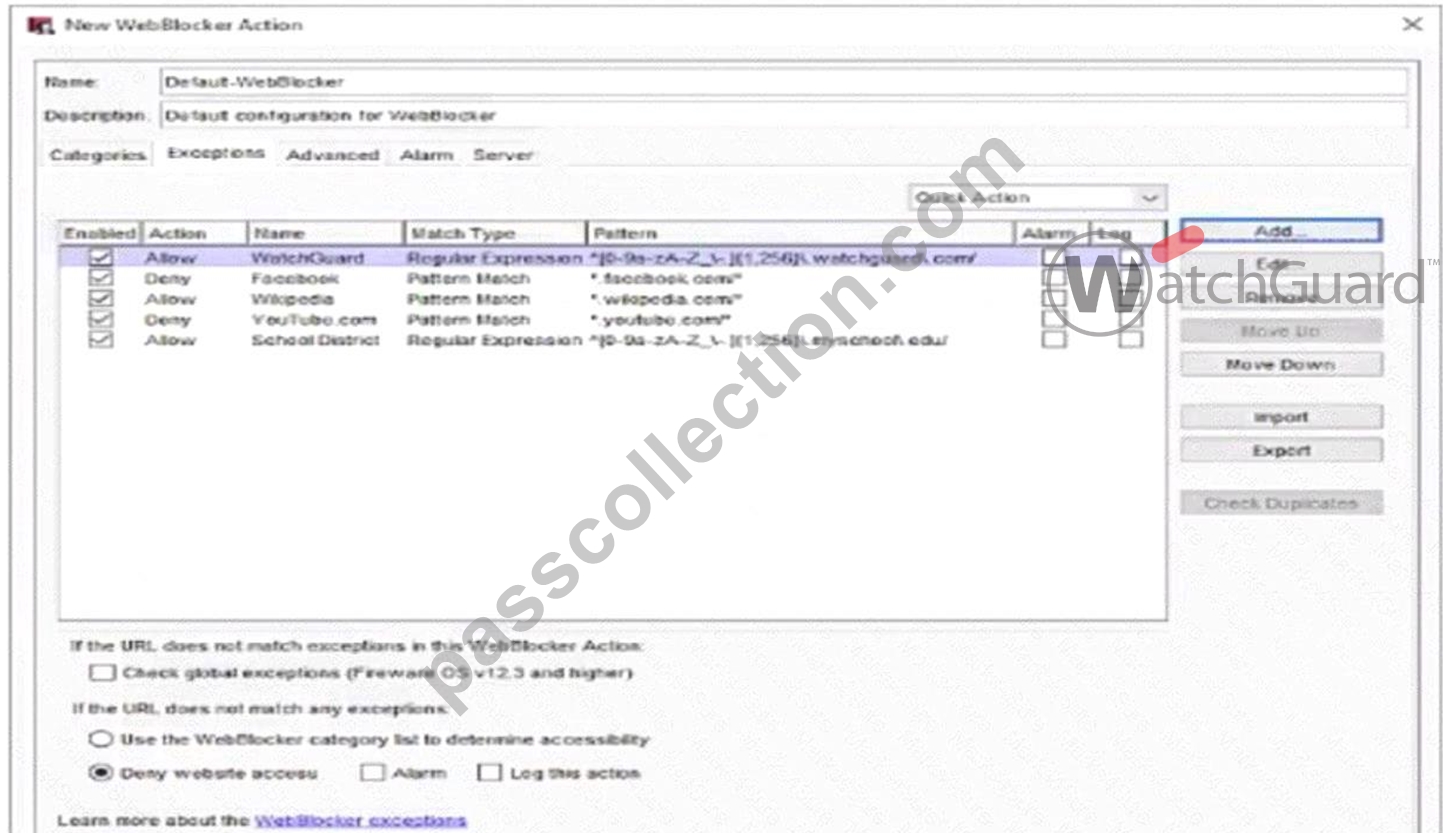
- A. www.wikipedia.com/firewall
- B. login.facebook.com
- C. www.youtube.com
- D. schedule.myschool.edu
- E. www.google.com
- F. www.watchguard.com/wgrd-blog
Answer: B,C,E
Explanation:
The WebBlocker action in the image contains bothAllowandDenyrules based on specific patterns:
* www.youtube.com- This is explicitly denied by the WebBlocker configuration for the pattern youtube.
com*.
* login.facebook.com- This would also be denied because it matches the pattern facebook.com*.
* www.google.com- There is no specificAllowrule for google.com or any associated subdomain, and since WebBlocker defaults toDenywhen a URL does not match any exceptions, www.google.com would be denied as well.
The other options:
* A.www.wikipedia.com/firewall- Allowed due to the wikipedia.com* pattern.
* D. schedule.myschool.edu- Allowed due to the regular expression matching *.myschool.edu.
* E.www.watchguard.com/wgrd-blog- Allowed by the regular expression for watchguard.com.
NEW QUESTION # 35
......
Best Value Available! 2026 Realistic Verified Free Network-Security-Essentials Exam Questions: https://www.passcollection.com/Network-Security-Essentials_real-exams.html
100% Accurate Answers! Network-Security-Essentials Actual Real Exam Questions: https://drive.google.com/open?id=1vqJqRlHQohail-_OfHmeYExrk9b4LB-n
