

A compelling certification highlights you. Attain the skills with the VMware Advanced VMware Cloud Foundation 9.0 Networking updated training questions at PassCollection: 64 practice questions for the 3V0-25.25 exam.
VMware 3V0-25.25 Exam Overview:
| Certification Vendor: | VMware |
|---|---|
| Exam Name: | Advanced VMware Cloud Foundation 9.0 Networking |
| Exam Number: | 3V0-25.25 |
| Related Certifications: | VMware Cloud Foundation Specialist certifications VMware Certified Professional - Data Center Virtualization (VCP-DCV) |
| Real Exam Qty: | 60-70 |
| Passing Score: | Scaled score 300 (on a 100-500 scale) |
| Exam Price: | USD 250-450 (varies by region) |
| Exam Format: | Multiple select, Drag and drop, Multiple choice, Scenario-based questions |
| Exam Duration: | 135-150 |
| Available Languages: | English |
| Certificate Validity Period: | 2 years |
| Recommended Training: | VMware NSX Training Courses VMware Cloud Foundation Training |
| Exam Registration: | Pearson VUE VMware Exams VMware Certification Portal |
| Sample Questions: |  |
| Exam Way: | Computer-based exam delivered via online proctoring or Pearson VUE test centers |
| Pre Condition: | Recommended: VMware Certified Professional (VCP-DCV) or equivalent hands-on experience with VMware Cloud Foundation and NSX networking |
| Official Syllabus URL: | https://www.vmware.com/education-services/certification.html |
VMware 3V0-25.25 Exam Syllabus Topics:
| Section | Objectives |
|---|---|
| Networking Architecture in VMware Cloud Foundation | - vSphere Distributed Switch configuration and design - NSX networking fundamentals and overlay architecture - Routing, BGP, and dynamic routing integration |
| Troubleshooting and Optimization | - Common VCF networking issues and resolution methods - Performance tuning and monitoring of NSX networks |
| Cloud Foundation Architecture and Design | - Design principles for scalable SDDC environments - VMware Cloud Foundation (VCF) architecture components |
| VCF Deployment and Operational Networking | - Network pool configuration and workload domain networking - Lifecycle management networking considerations |
| NSX-T Data Center Integration | - Logical switching and routing constructs - Edge services and gateway configuration - Security policies and micro-segmentation |
VMware 3V0-25.25 Exam: Standout Answers
The VMware Advanced VMware Cloud Foundation 9.0 Networking blueprint spans 5 domains — including NSX-T Data Center Integration, Networking Architecture in VMware Cloud Foundation, VCF Deployment and Operational Networking. The complete outline above lists every subtopic; work them from heaviest to lightest.
USD 250-450 (varies by region) per attempt, Scaled score 300 (on a 100-500 scale) to pass. Retakes cost the full fee — act now and prepare properly with the 64 practice questions for the 3V0-25.25 exam at PassCollection.
Yes — download the free VMware Advanced VMware Cloud Foundation 9.0 Networking demo and preview the quality before paying. Purchases include 365 days of free updates by email; renew afterward at 50% off.
Recommended: VMware Certified Professional (VCP-DCV) or equivalent hands-on experience with VMware Cloud Foundation and NSX networking Eligibility rules change over time, so verify the current requirements on the official page (official 3V0-25.25 exam page) before registering.
135-150 for 60-70 questions. The PassCollection SOFT version — most proximate to the real exam in style and mode — builds the pacing you need on any Windows computer.
Through the vendor's official registration channels:
The VMware Advanced VMware Cloud Foundation 9.0 Networking is delivered Computer-based exam delivered via online proctoring or Pearson VUE test centers — pick the arrangement that suits you when booking.
Upon successful payment, our system emails the VMware Advanced VMware Cloud Foundation 9.0 Networking vce torrent automatically within about a minute — apply it on any computer with no limitation, with 24/7 help if nothing arrives within 2 hours. If you fail the corresponding 3V0-25.25 exam within 60 days of purchase, we refund the full amount: send a scanned enrollment slip plus the official Score Report PDF within 2 days of the exam, processed within 7 days. Excluded: exams within 3 days of purchase, candidate names that don't match the payer, and free or expired products. Or exchange for two equal-value products free.
The VMware Advanced VMware Cloud Foundation 9.0 Networking is VMware's certification exam for VMware Certified Advanced Professional - VMware Cloud Foundation 9.0 Networking, at the Professional level. A compelling certification highlights you — from common to standout. Related credentials include VMware Certified Professional - Data Center Virtualization (VCP-DCV), VMware Cloud Foundation Specialist certifications.
Yes:
After any course, sharpen up with the 64 practice questions for the VMware Advanced VMware Cloud Foundation 9.0 Networking — every answer expert-verified.
VMware Advanced VMware Cloud Foundation 9.0 Networking Sample Questions:
Which two requirements are part of the registration process for Local Manager (LM) to a Global Manager (GM) in NSX for centralized management of network and security services across different workload domains deployed in separate locations? (Choose two.)
- A. The IP / FQDN of any of the 3 LM must be used for registration.
- B. The external load balancer VIP is used for NSX Managers without requiring node API certificate updates.
- C. The LM will validate the GM license to perform the GM registration.
- D. The LM Cluster VIP / FQDN is provided for GM-LM communication.
- E. The GM-Active requests the LM IP / FQDN and admin credentials for registration.
Correct Answer: D,E 🗳️
Explanation: Only visible for PassCollection members. You can sign-up / login (it's free).
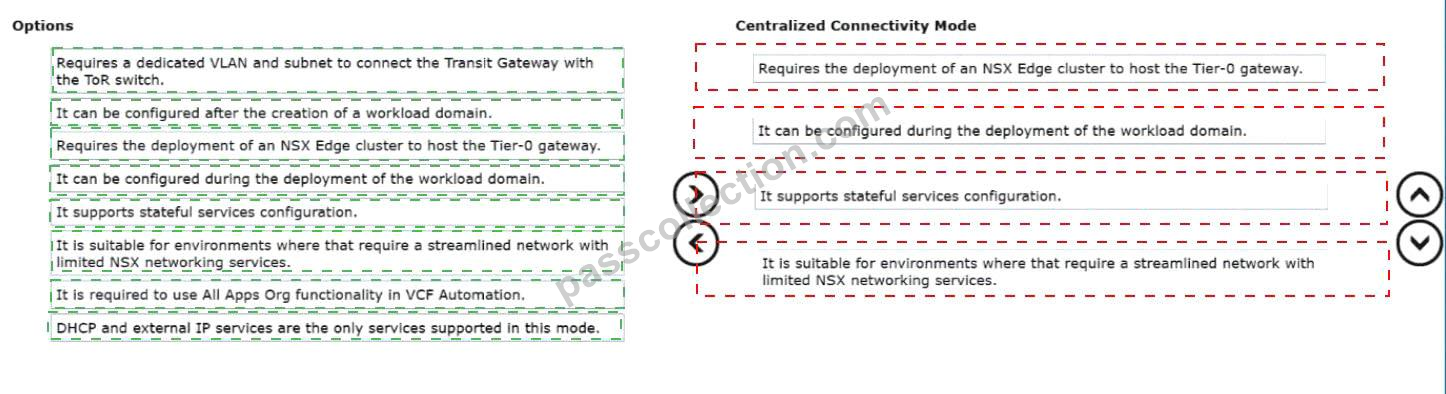
An administrator was asked to explain the characteristic and requirements of Centralized Connectivity Mode which is planned to be configured in one of the workload domains in VMware Cloud Foundation (VCF) environment.
Drag and drop four options from the Options list on the left and place them into the Centralized Connectivity Mode on the right in any order. (Choose four.)
Correct Answer:
Explanation:
* Requires the deployment of an NSX Edge cluster to host the Tier-0 gateway.
* It can be configured during the deployment of the workload domain.
* It supports stateful services configuration.
* It is suitable for environments that require a streamlined network with limited NSX networking services.
InVMware Cloud Foundation (VCF) 9.0, the networking architecture introduces specialized connectivity modes to cater to different organizational needs, withCentralized Connectivity Modebeing a primary option for streamlined deployments. This mode is fundamentally anchored to the physical infrastructure via localized resources rather than distributed components across the entire cluster.
The most critical technical requirement for this mode is that itrequires the deployment of an NSX Edge cluster to host the Tier-0 gateway. Unlike distributed models, centralized connectivity funnels North-South traffic through specific Edge nodes that serve as the demarcation point between the virtual overlay and the physical Top-of-Rack (ToR) switches. This centralization is what enables the next key characteristic: it supports stateful services configuration. Because traffic is anchored to specific Service Routers (SR) on Edge nodes, stateful operations such as NAT, Load Balancing, and stateful firewalls can maintain session persistence, which is not natively possible in a purely distributed Active/Active ECMP environment without specialized configuration.
From a lifecycle perspective, this mode is highly integrated into the SDDC Manager workflows andcan be configured during the deployment of the workload domain. This allows architects to define the networking posture of a new domain at "Day 0," ensuring that the necessary Edge resources and Tier-0/Tier-1 hierarchies are provisioned automatically to meet the domain's specific requirements.
Finally, Centralized Connectivity Modeis suitable for environments that require a streamlined network with limited NSX networking services. It provides a "cloud-lite" approach to networking, offering the necessary isolation and security of NSX without the complexity of managing a full-scale distributed fabric.
This makes it an ideal choice for smaller workload domains, specialized labs, or legacy application environments that do not require the massive scale of a distributed transit gateway but still need robust stateful security and simplified North-South egress.
An architect needs to allow users to deploy multiple copies of a test lab with public access to the internet. The design requires the same machine IPs be used for each deployment. What configuration will allow each lab to connect to the public internet?
- A. Configure DNAT rules on the Tier-1 gateway.
- B. Configure SNAT rules on the Tier-0 gateway.
- C. Configure isolation on the NSX segment.
- D. Configure firewall rules to isolate the traffic going to the public internet.
Correct Answer: B 🗳️
Explanation: Only visible for PassCollection members. You can sign-up / login (it's free).
An administrator has observed an NSX Local Manager (LM) outage at the secondary Site. However, the NSX Global Manager (GM) in secondary Site remains operational. What happens to data plane operations and policy enforcement at the secondary site?
- A. Secondary site must failover all workloads to Primary site.
- B. Only local policies work; global policies cease to apply on the secondary site.
- C. The data plane operates normally until LM recovery and reconnection.
- D. All traffic is blocked until secondary site LM recovers.
Correct Answer: C 🗳️
Explanation: Only visible for PassCollection members. You can sign-up / login (it's free).
An administrator has been tasked with providing a networking solution including a Source and Destination NAT for a single Tenant. The tenant is using Centralized Connectivity with a Tier-0 Gateway named Ten-A- Tier-0 supported by an Edge cluster in Active-Active mode. The NAT solution must be available for multiple subnets within the Tenant space. The administrator chooses to deploy a Tier-1 Gateway to implement the NAT solution. How would the administrator complete the task?
- A. Change Ten-A-Tier-0 to Active-Standby to support the stateful NAT.
- B. Create a new Tier-1 Gateway in Active-Standby mode and attach it to Ten-A-Tier-0.
- C. Create a new Tier-0 Gateway in Active-Standby mode and attach another Tier-1 Gateway.
- D. Create a Tier-1 Gateway in Distributed Routing mode only and do not attach it to Ten-A-Tier-0.
Correct Answer: B 🗳️
Explanation: Only visible for PassCollection members. You can sign-up / login (it's free).
Viewing page 1 out of 13 pages.
Viewing questions 1-5 out of 64 questions.


 Eunice

 Yetta

 Timothy
 Regina
 Christine
 Ida

 Vita
 Heather
 Joyce
 Gustave
 Joseph
 Winfred
 Owen
 Hamiltion
 Webb
 Ina
 Catherine


